
High-Performance Certified Cable Glands & Enclosure Sealing Systems
Direct factory-engineered cable entries with rigorous IP68 immersion protection, UL/CE compliance, and dynamic mechanical strain relief engineered for mission-critical enclosures.
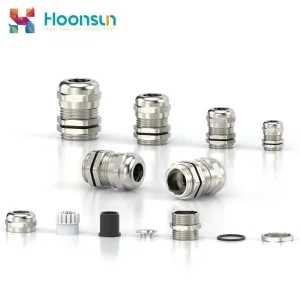
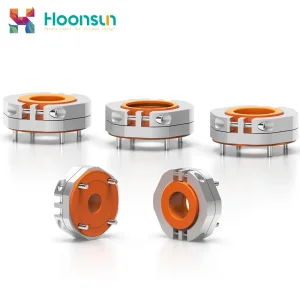
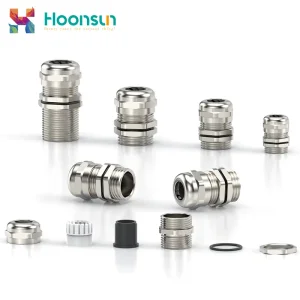
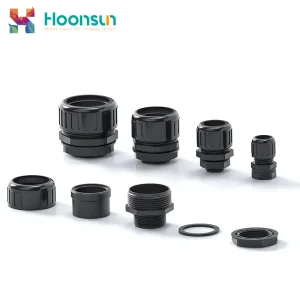
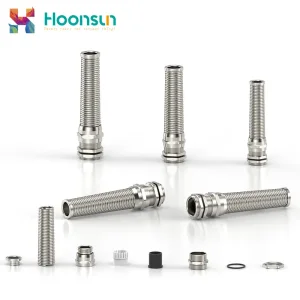
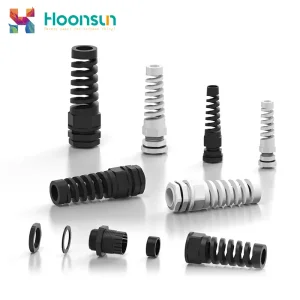
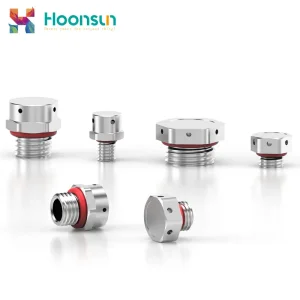
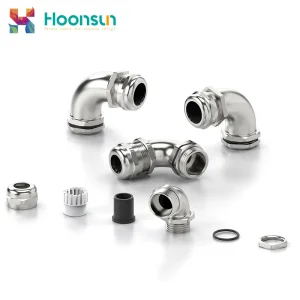
Engineering Paradigm Shift: Aluminum Alloy 6061/6082 in Cable Management
A rigorous examination of weight reduction, electromagnetic compatibility, mechanical tensile resilience, and total cost of ownership across industrial, commercial, and utility infrastructure.
In modern industrial electrification, the cable gland can no longer be treated as a passive mechanical hardware accessory. As system voltages in electric mobility (e-Mobility) scale toward 800V and 1000V DC architectures, utility-scale Energy Storage Systems (BESS) exceed megawatt-hour densities, and robotic automation platforms accelerate duty-cycle dynamics, the physical properties of cable entry components dictate overall system uptime, thermal equilibrium, and electromagnetic reliability. Within this rigorous context, aluminum cable glands have emerged as the definitive material choice, replacing conventional nickel-plated brass and stainless steel where lightweighting, non-magnetic performance, and optimized thermal dissipation are non-negotiable parameters.
China has established itself as the global epicenter for aluminum cable gland manufacturing, transitioning beyond simple machining into advanced precision metallurgy, proprietary surface anodization, and vertically integrated assembly ecosystems. Situated predominantly in the specialized manufacturing belt of Liushi, Yueqing, Chinese manufacturers harness world-class CNC turning centers, automated Swiss-type screw machines, and direct proximity to primary aluminum ingot refining. This concentration yields unmatched dimensional consistency, compliant thread tolerances (Metric ISO 965, NPT ANSI/ASME B1.20.1, PG DIN 40430, and Gas BSPP ISO 228), and full compliance with international testing frameworks including UL 514B, IEC/EN 62444, and IEC 60529.
| Material Specification | Density (g/cm³) | Tensile Strength (MPa) | Thermal Conductivity (W/m·K) | Magnetic Permeability (μ) | Relative Weight Impact | Primary Industrial Best-Fit |
|---|---|---|---|---|---|---|
| 6061-T6 Aluminum Alloy | 2.70 | 310 | 167 | 1.00002 (Non-magnetic) | Baseline: -66% vs Brass | EV Battery Trays, Energy Storage (BESS), Aviation |
| 6082-T6 Structural Aluminum | 2.71 | 340 | 170 | 1.00002 (Non-magnetic) | -65% vs Brass | High-Vibration Rail, Heavy Marine Machinery, Wind Nacelles |
| Nickel-Plated Brass (HPb59-1) | 8.45 | 390 | 115 | 1.001 (Trace) | +195% vs Aluminum | General Industrial Machinery, Static Switchgear |
| AISI 316L Stainless Steel | 8.00 | 580 | 16.3 | 1.008 (Low) | +190% vs Aluminum | Offshore Oil & Gas, Sanitary Pharmaceutical, Acidic Washdown |
| Polyamide PA66 (Reinforced) | 1.14 | 85 | 0.24 | 1.00000 | -58% vs Aluminum | Low-Mechanical Outdoor Panels, PV Junction Boxes |
Mass Reduction & Zero Eddy Losses
Aluminum alloys 6061 and 6082 provide an approximate 65% weight reduction over brass. Crucially, aluminum’s non-ferrous magnetic permeability eliminates localized hysteresis and eddy current induction heating around high-amperage alternating current (AC) single-core cables.
Advanced Anodic Barrier Layers
Through sulfuric acid anodizing (Type II) or hardcoat anodizing (Type III, MIL-A-8625), Chinese manufacturers impart an amorphous aluminum oxide film up to 25–50μm thick, achieving exceptional dielectric insulation, scratch hardness up to 450 HV, and over 1,000 hours of neutral salt spray (ASTM B117) resistance.
Superior EMC / EMI Shielding Integrity
Equipped with beryllium copper or phosphor bronze multi-point radial grounding spring fingers, our aluminum cable glands ensure seamless, 360-degree high-frequency attenuation. Transfer impedance values remain below 10 mΩ/m across the 100 kHz to 1 GHz band, vital for variable-frequency motor drives.
China Factory Infrastructure: Vertical Integration & Agile Delivery
How the Yueqing and Liushi industrial micro-clusters enable scalable precision, rapid prototyping, and cost predictability for Tier-1 engineering procurement.
The manufacturing supremacy of Chinese cable gland producers is anchored in Yueqing, Zhejiang Province, globally recognized as the electric apparatus capital of China. Within a compact radius of under 20 kilometers, an entire end-to-end industrial value chain operates in synergistic synchronicity. From dedicated hot-extrusion billet mills to multi-axis CNC lathe centers, automated injection molding of PA66 / NBR sealing claws, electroplating lines, and certified quality-testing laboratories, this geographic density creates unparalleled manufacturing velocity.
Western procurement managers sourcing from leading Chinese factories experience profound advantages over fragmented Western supply lines:
Direct Billet Extrusion & Casting
By purchasing primary A00 virgin aluminum ingots directly from major domestic smelters, Chinese plants insulate international buyers from speculative commodity price spikes. Controlled secondary reheating and continuous extrusion ensure void-free microstructure, eliminating porous defects during high-pressure hydro-testing.
Automated Multi-Axis CNC Turning
Utilizing high-speed CNC multi-spindle automatic screw machines with live tooling, threading and internal boring are executed in a single cycle setup. Thread pitch error is held within ±0.005mm, preventing cross-threading or mechanical binding during on-site torqueing onto aluminum, steel, or composite distribution boxes.
Bespoke OEM / ODM Rapid Prototyping
Equipped with internal toolmaking workshops, custom clamping profiles, non-standard entry thread lengths (up to 45mm for thick thermal insulation walls), and unique gland body shapes transition from digital CAD/STEP models to physical validation samples in as few as 5 to 7 working days.
Addressing Global Sourcing Demands: Specs, Clamping & Sealing
A granular technical blueprint for project specifiers: thread forms, elastomeric compounding, armour wire retention, and thermal cycling validation.
Procurement directors and chief electrical engineers representing global EPCs (Engineering, Procurement, and Construction) demand full transparency regarding dimensional standards, dynamic ingress longevity, and elastomer material science. An aluminum cable gland must withstand rigorous pull-out tension (tensile retention Class A/B under EN 62444) without compromising internal cable conductor insulation or generating localized cold flow.
Global Thread Standards Coverage
Metric (M12 to M110): 1.5mm pitch per ISO 965-1; optional 2.0mm pitch for large frame sizes.
NPT (3/8" to 4"): 60° taper per ANSI/ASME B1.20.1 for explosion-proof flame-path seal engagement.
PG (PG7 to PG48): 80° flank per DIN 40430 for legacy European machinery maintenance.
Gas / BSPP (G1/4" to G4"): Parallel cylindrical thread per ISO 228-1.
Engineered Sealing Elastomers
Standard NBR (Nitrile): -40°C to +100°C, outstanding oil, grease, and aliphatic hydrocarbon resistance.
EPDM Rubber: -40°C to +140°C, optimized for aggressive UV, ozone weathering, and outdoor solar parks.
High-Temp Silicone: -60°C to +200°C, essential for extreme arctic cryogenics or high-heat engine bays.
Viton / FKM: -20°C to +200°C, total inertness against aromatic fuels, solvents, and aggressive chemicals.
Armoured Cable Retention & Earth Continuity
Single Wire Armoured (SWA), Aluminum Wire Armoured (AWA), and Steel Tape Armoured (STA) cables require continuous mechanical grounding. Our precision clamping cones and reversible armour rings guarantee low-resistance electrical bonding (<0.1 Ω) while securing mechanical pull-out force exceeding 1,000 N.
Regulatory Assurance: Bridging Yueqing to North America & Europe
Eliminating sourcing friction through internationally verified third-party laboratory accreditations and localized engineering documentation.
A primary failure mode in overseas sourcing is the regulatory mismatch between Chinese domestic testing criteria and strict localized standards enforced by municipal electrical inspectors or marine classification societies. Tier-1 Chinese manufacturers circumvent this issue by maintaining active direct certifications through UL (Underwriters Laboratories), TÜV Rheinland, DEKRA, and Intertek.
Our aluminum cable glands comply thoroughly with the following structural regulatory benchmarks:
UL 514B & CSA C22.2 No. 18.3
Full listing status for conduit, tubing, and cable fittings across the United States and Canada. Validation encompasses extreme pull-out tensile tests, sealing gasket aging in elevated air-ovens, and physical impact resistance at sub-zero temperatures (-35°C) without cracking.
ATEX / IECEx Hazardous Locations
Certified for explosive atmospheres under EN/IEC 60079-0 (General), 60079-1 (Flameproof 'd'), and 60079-7 (Increased Safety 'e'). Precision aluminum alloys strictly restrict magnesium content below 6% mass to eliminate incendiary spark risk in Zone 1, Zone 2, Zone 21, and Zone 22 deployments.
IP68 Hydrostatic & IP69K High-Pressure Wash
Sealing capability certified under IEC 60529 to IP68 rating at continuous immersion depths up to 5 bar (50m) or 10 bar (100m) for agreed durations. Certified DIN 40050-9 / ISO 20653 IP69K compliance ensures zero ingress against 100 bar high-pressure, 80°C steam water jets.
Mission-Critical Use Cases Across Global Mega-Projects
From high-vibration autonomous logistics to offshore renewable substations, discover how aluminum cable glands safeguard electrical pathways.
Next-Gen EV Battery Packs & On-Board Power Electronics
Automotive battery enclosure architectures require minimum unsprung mass and hermetic sealing to guard sensitive lithium cells against water intrusion during flooded road traversal. Aluminum glands match the thermal expansion coefficients of aluminum cast enclosures, preventing thermal-cycling gasket gaps while draining high-frequency inverter noise to chassis ground.
Utility-Scale Solar (PV) & High-Capacity BESS Containers
In 1500V DC photovoltaic power plants located in desert environments (Atacama, Middle East, Southwest US), diurnal temperature swings span -10°C to +50°C. Anodized aluminum cable glands resist UV brittleness—a common failure mode of nylon glands—and withstand wind-borne abrasive silica sands without surface degradation.
High-Speed Rail, Rolling Stock & Metro Sub-Carriages
Underbody rolling stock electrical conduits endure continuous multi-axis vibration, ballistic ballast stone strikes, and wide temperature gradients. Aluminum 6082-T6 cable glands provide robust mechanical clamping without the massive inertial penalty of heavy brass, passing rigorous EN 61373 Category 1 Class B shock/vibration testing.
Robotics, Cobots & Automated Guided Vehicles (AGVs)
Robotic wrist joints and automated gantry tracks require flexible anti-bending strain relief. Aluminum glands paired with stainless steel or heavy polyamide bend-limiting spirals ensure continuous flexing without conductor kink failure, reducing cycle fatigue in 24/7 manufacturing plants.
Offshore Wind Turbines & Marine Topside Enclosures
In offshore nacelles and transition pieces, high salinity accelerates galvanic reaction. Specially treated marine-grade aluminum glands—incorporating non-conductive dielectric isolation washers (PTFE or Delrin) and stainless-steel hardware—provide decades of corrosion-free performance in high-humidity marine spray.
AI Data Centers & Liquid Cooling Server Racks
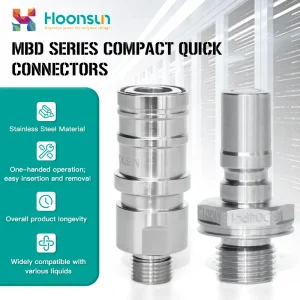
With high-density AI clusters adopting direct-to-chip and immersion liquid cooling, aluminum cable glands and quick-connect liquid fittings maintain non-drip sealing. Their high thermal conductivity helps dissipate heat from heavy copper DC bus cables penetrating sealed cooling chambers.
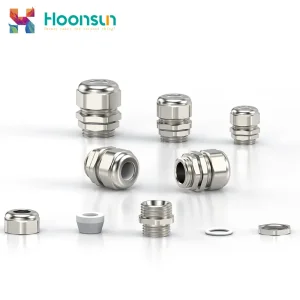
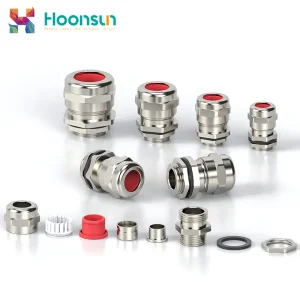
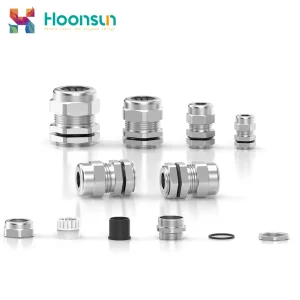
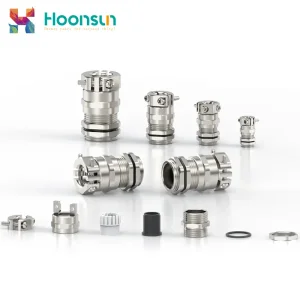
Extended Industrial Cable Glands & Fluid Coupling Connectors
Explore heavy-duty armored gland assemblies, high-temperature formulations, and precision liquid cooling connectors produced in our certified workshops.
Frequently Asked Questions (FAQ)
In-depth technical answers addressing galvanic compatibility, torque parameters, explosive atmospheres, and lead-time logistics for international buyers.
How do you mitigate galvanic corrosion when threading aluminum cable glands into stainless steel or carbon steel enclosures?
Galvanic corrosion occurs when two dissimilar metals are coupled in the presence of an electrolyte (e.g., seawater or moisture) and their electrochemical potential difference exceeds 0.15V in harsh environments or 0.25V in benign industrial conditions. When threading an aluminum cable gland (anodic relative to steel) into a stainless steel enclosure (cathodic), aluminum will naturally sacrifice itself over time unless isolated.
To eliminate this failure mode, our factory provides a three-tiered isolation system: (1) Hard-anodized or trivalent chromate surface treatment that converts the surface into an electrically insulating oxide dielectric layer; (2) Pre-fitted non-conductive dielectric sealing washers manufactured from virgin PTFE, chloroprene, or engineered Delrin; and (3) Factory-applied anti-seize dialectic barrier pastes formulated with non-metallic lubricants. This ensures zero galvanic cell bridging across a 25-year operational lifecycle.
What are the key metallurgical differences between Aluminum 6061-T6 and 6082-T6 in cable gland construction?
Both 6061 and 6082 belong to the Al-Mg-Si (6000-series) precipitation-hardened aluminum family, yet they serve distinct structural roles in cable gland engineering. Aluminum 6061-T6 contains silicon (0.4-0.8%), iron (0.7%), copper (0.15-0.40%), and magnesium (0.8-1.2%). It is the premier standard in the North American market, offering exceptional machining chip control, balanced mechanical yield strength (around 276 MPa), and high surface finish receptivity for hardcoat anodizing.
In contrast, 6082-T6 is the dominant European structural alloy (DIN EN 573-3). It contains significantly higher manganese content (0.4-1.0%), which refines the grain structure and increases ultimate tensile strength to over 340 MPa (approx. 10–15% higher than 6061). This makes 6082-T6 our top recommendation for heavy-vibration applications, such as high-speed rail rolling stock undercarriages, marine winch terminations, and offshore wind generator nacelles where repeated dynamic shock loading occurs.
What criteria determine IP68 continuous immersion performance versus IP69K dynamic washdown?
While often conflated, IP68 and IP69K represent radically different environmental stress vectors under IEC 60529 and ISO 20653 / DIN 40050-9:
IP68 Continuous Submersion: Testing evaluates hydrostatic head pressure. Unlike IP67 (which only tests at 1 meter for 30 minutes), IP68 requires manufacturer-specified depth and duration testing. HOONSUN aluminum glands are validated at 5 bar (50 meters hydrostatic depth) for 7 days or 10 bar (100 meters) for 24 hours. The primary failure mode is seal deformation or hydrostatic creep under sustained pressure.
IP69K High-Pressure Thermal Washdown: Testing evaluates resistance to localized dynamic kinetic fluid forces. The gland is mounted on a rotating turntable (5 ± 1 rpm) and subjected to high-pressure water jets at 80–100 bar (1,160–1,450 PSI), at a temperature of 80°C, with a nozzle distance of 100–150mm across angles of 0°, 30°, 60°, and 90°. Failure here occurs due to hydraulic tearing or thermal elastomer relaxation.
Can aluminum cable glands be deployed safely in ATEX / IECEx Zone 1 and Zone 2 hazardous areas?
Yes, provided the specific aluminum alloy composition complies with the strict material limitations of EN/IEC 60079-0 Clause 8. In hazardous explosive gas atmospheres (specifically Zone 1 and Zone 2), lightweight alloys containing high percentages of magnesium, titanium, or zirconium represent a catastrophic risk of frictional sparking upon impact with rusty iron or steel (the thermite ignition phenomenon).
For ATEX/IECEx certified Ex-d (flameproof) and Ex-e (increased safety) product lines, our engineering foundry strictly regulates light metal alloys to contain less than 6% magnesium and titanium combined by weight. Furthermore, thread flame-path tolerances (spigot gaps and minimum fully engaged thread pitches) are CNC-machined to micro-tolerances exceeding EN 60079-1 standards, ensuring that any internal ignition cannot propagate into the surrounding ambient flammable atmosphere.
How does the tightening torque of an aluminum cap nut compare to brass and stainless steel?
Because the shear modulus and yield strength of aluminum alloys differ from brass and 316 stainless steel, tightening torque profiles must be engineered precisely to achieve full IP68 sealing claw deformation without galling the aluminum threads or over-compressing the cable sheath.
For example, in a standard M25 × 1.5 cable gland clamping a 13.0–18.0mm cable outer diameter: a brass gland typically requires 8.0–10.0 Nm; a 316L stainless gland requires 12.0 Nm; while an aluminum 6061-T6 gland is engineered to achieve complete hermetic seal compression at 7.0–8.5 Nm. Over-torqueing aluminum past 14 Nm risks plastic deformation of the internal thread flanks. We provide standardized torque data sheets for every thread size and part number, and can supply calibrated torque-break shear nuts for mission-critical installations.
What are typical production lead times, minimum order quantities (MOQ), and PPAP documentation options?
Leveraging our automated CNC manufacturing center in Yueqing, standard catalog sizes (M16 through M63, NPT 1/2" through 2") are maintained in ready-buffer stocks of 10,000+ pieces per SKU, enabling dispatch within 3 to 5 business days. For customized OEM modifications (custom thread lengths, special clamping ranges, custom color anodizing, or specific elastomer compounds), production runs are completed within 15 to 22 calendar days.
MOQ for catalog products starts at 500 units. For automotive (EV) and energy storage (BESS) programs, our engineering quality team routinely furnishes complete PPAP (Production Part Approval Process) Level 3 documentation packages, including Material Test Certificates (MTR 3.1), Process Failure Mode Effects Analysis (PFMEA), Control Plans, Gage R&R studies, and Full Dimensional CMM Inspection Reports.
Connect Directly with Our Cable Gland Application Engineers
Whether you require custom STEP 3D CAD modeling, custom thread adaptations, or third-party compliance verification test reports for your next mega-project tender, our technical specialists respond within 24 business hours.