
High-Spec Cable Gland Selections for US Systems
Engineered to withstand rigorous dynamic tension, ingress extremes, and aggressive environmental exposure across heavy industrial assemblies.
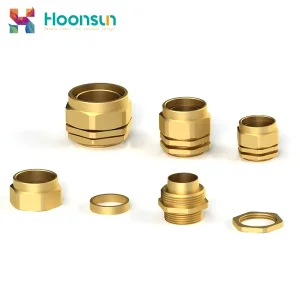
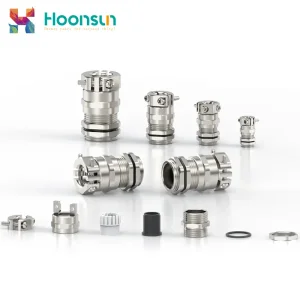
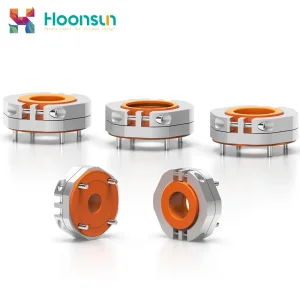
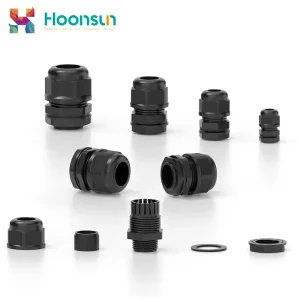
The United States Industrial Modernization: Structural Demands on Cable Entry Systems
Federal legislative mandates and modern industrial mega-projects are driving an unprecedented requirement for high-integrity cable gland hardware.
Infrastructure Legislation & Re-Industrialization
The convergence of the Bipartisan Infrastructure Law (IIJA), the Inflation Reduction Act (IRA), and the CHIPS and Science Act has unlocked over $1.2 trillion in domestic American capital allocation. From semiconductor fabrication cleanrooms in Arizona and Ohio to massive utility-scale Battery Energy Storage Systems (BESS) across the ERCOT and CAISO grids, the physical execution of projects hinges on uncompromising containment reliability.
In modern industrial facilities, electrical engineers are systematically transitioning from conventional rigid metal conduit (RMC) with pour-seals to certified direct-entry cable gland architectures. This transition yields significant savings in installation labor, enhances termination density by up to 45%, and mitigates condensation transfer between environmental zones.
The Demanding North American Regulatory Framework
Navigating the United States electrical landscape requires rigorous adherence to statutory codifications governed by NFPA 70 (The National Electrical Code - NEC). Unlike IEC-centric global markets where European harmonized standards (EN 50262 / IEC 62444) dominate, American inspectors (AHJs - Authorities Having Jurisdiction) mandate explicit listing under ANSI/UL standards.
- UL 514B Standards: Validates stringent mechanical pullout tension, water-seal immersion, and continuous grounding continuity paths.
- NEMA 250 Ingress Verification: Achieving NEMA 4, 4X (corrosion resistance), and NEMA 6P (prolonged submersion) ratings.
- NEC Hazardous Classifications: Addressing Class I, Division 1 and 2 explosion-proof gas ignition containment protocols.
Engineering Specification Matrix: North American vs. International Compliance
A rigorous dimensional and regulatory reference for EPC contractors, design firms, and procurement executives deploying hardware in US operations.
| Performance Dimension | United States Standard (UL/NEC) | International Standard (IEC/EN) | Engineering Implication & Failure Mode |
|---|---|---|---|
| Thread Profile | ANSI/ASME B1.20.1 NPT (National Pipe Taper) | ISO Metric (M-Thread) / DIN 40430 (PG) | NPT uses 1°47' taper providing mechanical flank-to-flank sealing; parallel metric threads depend strictly on O-ring face seals. |
| Environmental Sealing | NEMA 250 (Type 4X, 6P Submersion) | IEC 60529 (IP66, IP67, IP68) | NEMA 4X incorporates harsh freeze-thaw cycles and severe salt spray corrosion metrics absent in standard IP ratings. |
| Pullout Strain Relief | UL 514B Pullout Table (Up to 300+ lbs) | IEC 62444 Retention Classes (Type A / B) | UL mandates continuous mechanical retention without cable displacement under heavy dynamic industrial vibration. |
| Flammability Criteria | UL 94 Vertical Burning (V-0, V-1, 5VA) | IEC 60695 Glow-Wire Flammability Index | UL 94-V0 demands flame extinguishment within 10 seconds without dripping flaming particulate onto surrounding equipment. |
| Grounding Continuity | UL 467 Grounding & Bonding Evaluation | IEC 62444 EMC Peak Surge Dissipation | Ensures metal cable glands dissipate prospective short-circuit fault currents safely through enclosure walls without arcing. |
China Smart Manufacturing 4.0: Built for Global Supply Chain Resilience
How state-of-the-art precision robotics, integrated vertical supply ecosystems, and algorithmic QC solve procurement lead-time bottlenecks for American OEMs.
Sub-Micron Machining Tolerances
Our Industry 4.0 facility leverages high-speed, multi-axis Swiss CNC turning centers operating with dimensional feedback loops. Capable of maintaining threading tolerances within ±0.01mm, we eliminate thread-binding and pitch misalignment issues on critical NPT 1/4" through NPT 4" industrial entries.
Automated Material Formulations
For metallic ranges, our foundries deploy continuous spectrographic brass analysis ensuring strict dezincification-resistant alloys (CuZn39Pb3, C36000) and Marine 316L Stainless Steel. For polymer components, closed-loop drying and injection molding utilize UL-verified virgin PA66 compounds with advanced halogen-free flame retardants.
Vision-AI Quality Verification
Human inspection is augmented by automated optical inspection (AOI) lines scanning 100% of sealing grommets, lock nuts, and thread entry shoulders. Every single unit is visually audited for surface burrs, O-ring groove depth, and seal eccentricity prior to bulk export boxing.
High-Consequence Application Scenarios Across North America
Engineered to mitigate catastrophic ingress, mechanical degradation, and operational disruption across vital geographic and industrial sectors.
Gulf Coast Petrochemical & LNG Export Corridors
Operating along the Texas and Louisiana coastal corridors exposes electrical enclosures to hyper-saline humidity, ambient temperatures surging past 105°F (40°C), and airborne corrosive sulfur gases. Our explosion-proof barrier cable glands and marine-grade 316L stainless steel assemblies provide Class I, Div 1 flamepath sealing, blocking internal explosive gas ignition migration and guaranteeing absolute NEMA 4X salt-spray resistance.
Utility-Scale Solar & Utility BESS (ERCOT & CAISO)
Desert solar facilities in Nevada, California, and West Texas undergo severe diurnal thermal cycling ranging from freezing nights to blistering midday heat, inducing expansion and contraction in standard rubber cable boots. Our modified EPDM and silicone sealing cable glands maintain constant dynamic radial pressure over unarmored multi-conductor DC strings, eliminating cold flow phenomena and stopping micro-moisture siphoning.
AI Data Centers & Liquid Cooling Thermal Infrastructure
The explosive buildout of Hyperscale Artificial Intelligence clusters across Northern Virginia and the Pacific Northwest requires dense, modular liquid cooling loops running fluorochemical or water-glycol coolants directly alongside high-current busbars. Our specialized liquid cooling connectors and cable penetration glands seal critical manifolds to IP68 standards, ensuring zero drip risk to multi-million-dollar GPU server racks.
Heavy Machinery & Automotive Gigafactory Automation
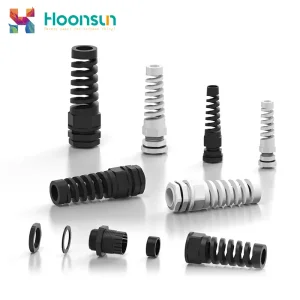
Automated manufacturing plants in Michigan, Tennessee, and Kentucky rely on high-speed collaborative robotic arms subject to torsional stress and synthetic cutting oil spray. Our metal hose cable glands and anti-bending nylon spiral cable glands offer high-flex strain relief, safeguarding high-bandwidth industrial Ethernet and servo drive lines against mechanical fatigue failure.
Frequently Addressed Engineering & Procurement Questions
Expert insights regarding standards compliance, installation torque parameters, and material optimization for the US market.
Why is NPT thread critical over Metric for US industrial sites?
NPT (National Pipe Taper) utilizes a 60° thread angle with a 1°47' taper. As the gland is torqued into an enclosure hub, the thread crests and roots mechanically deform and wedge together, forming a pressurized fluid barrier. Parallel Metric threads do not create a seal along the flanks and depend entirely on an external O-ring gasket compressed against a perpendicular planar surface.
How do HOONSUN glands counter insulation cold flow in cables?
Cold flow occurs when the compressive stress applied by a sealing gland exceeds the yield strength of the inner cable bedding, causing the jacket polymer to migrate away over time and compromising seal integrity. Our engineered double-lock and diaphragm-type clamping inserts distribute clamping force over an extended axial surface area, preventing concentrated localized pinching.
What is the distinction between IP68 and NEMA 4X / NEMA 6P?
IP68 (IEC 60529) only certifies ingress resistance against continuous water submersion under specified depth and time parameters. NEMA 250 Type 4X additionally tests for mechanical corrosion resistance against corrosive salts and acids, as well as external ice formation. NEMA 6P mandates prolonged underwater immersion while retaining internal enclosure dryness.
When should Nickel-Plated Brass be specified over 316L Stainless?
Nickel-plated brass provides superior electromagnetic shielding (EMC), excellent thermal conductivity, and robust mechanical pullout at an economical price point, making it ideal for indoor machinery, EV power electronics, and mining switchgear. Grade 316L Stainless Steel is necessary when dealing with chlorines, offshore washdown acids, and coastal splash zones.
Can you provide custom-engineered private labeling for US brands?
Yes. As an authentic primary manufacturer with internal tooling, moulding, and automated laser marking, we engineer customized thread extensions, custom clamping matrices, specialized fluorosilicone low-temp seals (-50°C), and full private label packaging programs for major North American automation suppliers.
What documentation accompanies OEM export shipments to the US?
Each production batch includes a Certificate of Analysis (COA), Mill Test Reports (MTR) verifying metal chemical composition, UL & CE compliance certificates, RoHS/REACH environmental compliance disclosures, and precise dimensional inspection sheets verified by optical QA scanners.
Specialized Cable Glands & Termination Hardware
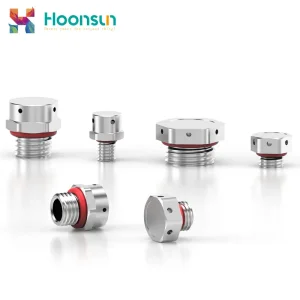
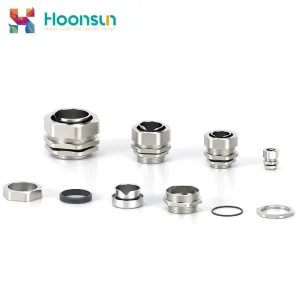
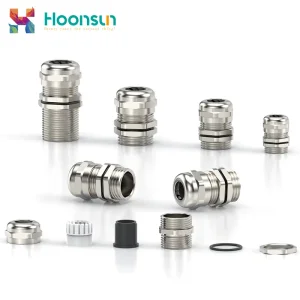
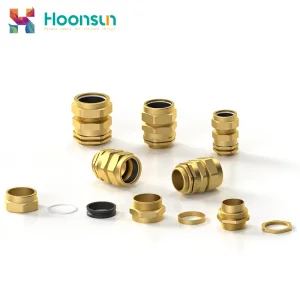
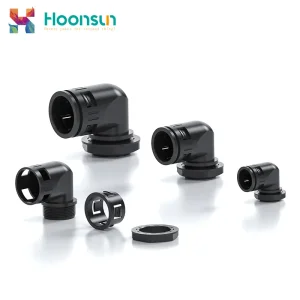
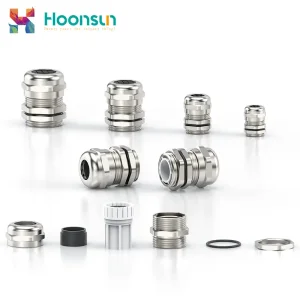
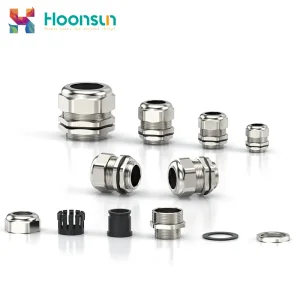
Explore our complete lineup of UL-tested vent plugs, hose glands, and high-performance metallic fittings.
Connect Directly with Our US Application Engineering Team
Accelerate your project qualification cycles. Request certified CAD drawings, UL compliance files, material certifications, and rapid-dispatch evaluation samples today.
Send Inquiry Now