
High-Performance Certified Cable Glands: Primary Assembly Matrix
Original high-tensile metal, marine, and explosion-proof glands manufactured under strict micro-tolerance CNC lathe operations and fully compliant with global ingress requirements.
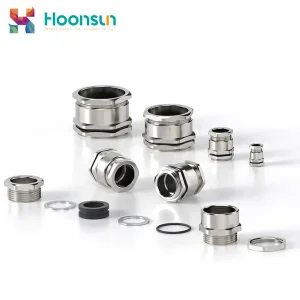
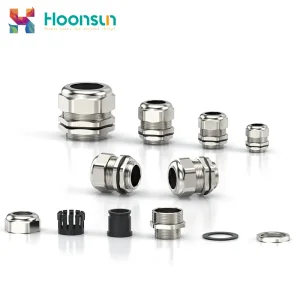
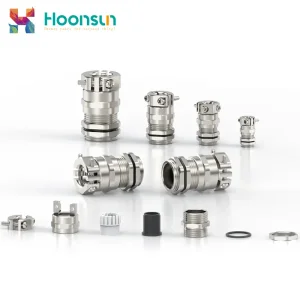
Global Industrial Landscape: The Macroeconomic Shift to Aluminium Cable Glands
Analyzing the intersection of lightweighting imperatives, high-voltage electrification, and metallurgical innovation across international electro-mechanical supply chains.
Across the global mechanical, electrical, and plumbing (MEP) sector, the global demand for industrial aluminium cable glands has expanded beyond standard commoditized hardware into highly engineered connection systems. Driven by aggressive decarbonization mandates, electric vehicle (EV) infrastructure scaling, offshore renewable deployments, and automated rolling stock construction, electrical design engineers are systematically auditing enclosure entry points. Traditional nickel-plated brass components—long considered the historical standard for mechanical strength—are increasingly being scrutinized due to significant density penalties (brass density approx. 8.4–8.7 g/cm³ versus 6061 aluminium alloy at 2.70 g/cm³). This represents an immediate weight reduction of approximately 68% per cable termination, a critical parameter in transport sectors, robotics, and aerial installations.
Furthermore, contemporary electrical installations are encountering severe electromagnetic noise and higher operating voltages, particularly in multi-megawatt Battery Energy Storage Systems (BESS) and 800V-to-1200V automotive DC traction architectures. Modern aluminium cable glands, when treated with precision hard-anodizing or electroconductive passivation, provide an exceptional conductivity-to-weight ratio while maintaining continuous 360-degree shielding against low-to-high frequency electromagnetic interference (EMI). China's industrial ecosystem, anchored by vertically integrated manufacturing powerhouses such as Zhejiang Hongxiang Connector Co., Ltd. (HOONSUN), operates at the global vanguard of this transformation, merging advanced metallurgical smelting with automated multi-spindle CNC machining to satisfy the most rigorous international engineering tolerances.
Metallurgical Formulation & High-Integrity Surface Passivation
Engineering robust alloy composition, compression geometry, and anti-galvanic surface finishes for mission-critical electrical integrity.
Alloy Selection: 6061-T6 vs 6082-T6
We utilize certified wrought structural alloys. 6061-T6 delivers balanced yield strength (276 MPa) and excellent machinability, while 6082-T6 offers superior ultimate tensile strength (up to 310 MPa) and heightened resistance to micro-fissuring in sub-zero mechanical installations.
Anti-Galvanic Surface Engineering
Direct contact between bare aluminium and dissimilar metals (e.g., steel enclosure panels or copper braided shields) creates rapid galvanic potential differentials. Our factory applies Type III Hard Anodizing or conductive trivalent chromate chemical conversion coatings (MIL-DTL-5541) to completely inhibit bimetallic corrosion cells.
Elastomeric Memory Under Cycling
Gland sealing integrity hinges entirely on the inner elastomeric grommet. We formulate custom chloroprene, high-grade EPDM, and specialized fluoroelastomer (FKM/Viton) compression rings, preventing permanent compression set under continuous thermal swings spanning from -60°C to +180°C.
| Material Classification | Specific Density (g/cm³) | Tensile Strength (MPa) | Thermal Conductivity (W/m·K) | Corrosion Resistance Class | Primary Industrial Sector |
|---|---|---|---|---|---|
| 6061-T6 Aluminium (Passivated) | 2.70 (Lightweight) | 310 | 167 | High (Anodized / Trivalent) | EV Powertrains, BESS, Aviation, Rail |
| Nickel-Plated Brass (CW614N) | 8.44 (Heavy) | 380 - 440 | 115 | Moderate to High | General Machinery, Commercial Panels |
| 316L Marine Stainless Steel | 8.00 (Heavy) | 500 - 650 | 16.3 (Low) | Extreme (Chloride / Acid) | Offshore Platforms, Chemical Plants, Pharma |
| Polyamide PA66 (Nylon 66) | 1.14 (Ultra-light) | 75 - 85 | 0.24 (Insulator) | Total Corrosion Immunity | Solar Junction Boxes, Lighting, HVAC |
Engineered for Global Ecosystems: Localized Application Scenarios
Customized ingress specifications, regional electrical standard compliance, and real-world deployment challenges across primary economic sectors.
North America (US & Canada)
Standard Alignment: UL 514B, CSA C22.2 No. 18.3, and NEC Hazardous Locations (Class I, II, III).
Application: Utility-scale solar inverters in desert climates (Arizona/Nevada) and EV gigafactories. Our aluminium cable glands feature true ANSI/ASME B1.20.1 NPT threads, preventing thread galling during rapid air-impact tool torquing while resisting intense solar UV embrittlement.
European Union & UK
Standard Alignment: EN 62444, ATEX Directive 2014/34/EU, and RoHS/REACH compliance.
Application: Offshore North Sea wind turbine nacelles and automated packaging plants. Utilizing Metric threads (EN 60423) with precision pitch control (1.5mm), incorporating 360-degree EMC earthing rings that seamlessly strip back armored braided cables (SWA/STA) without mechanical pinching.
Middle East (GCC Region)
Standard Alignment: IECEx Ex d / Ex e, high ambient rating T6 (+85°C).
Application: Petrochemical processing plants in Jubail and offshore platforms in the Arabian Gulf. Where airborne particulate sand meets 50°C+ ambient temperatures and 95% coastal saline humidity, our dual-seal barrier aluminium glands prevent sulfur and hydrocarbon gas ingress into flameproof enclosures.
Electrification in Rolling Stock and Hydrogen Transport (APAC Focus)
In high-speed rail networks across China, Japan, and Southeast Asia, unsprung mass reduction directly correlates with track infrastructure longevity and energy consumption profiles. HOONSUN’s lightweight aluminium cable glands are rigorously certified under EN 45545-2 (fire behavior on railway vehicles) for Hazard Level HL3. Our proprietary mechanical clamping claw distributes continuous radial pressure evenly over flexible elastomer-sheathed multi-core cables, preventing insulation cold flow or longitudinal cable migration during continuous 15G vibration shocks along high-speed rail bogeys.
China Factory Precision: Yueqing Industrial Cluster Synergies
Vertical manufacturing architecture: From billet extrusion and automated multi-axis machining to microscopic optical quality assurance.
Direct Billet Extrusion Integration
Operating in Liushi, Yueqing—the world-renowned capital of electrical hardware—we maintain direct tier-1 supply partnerships with primary aluminium smelting centers. This guarantees certified raw alloy chemical consistency (RoHS compliance, low lead content <0.1%) while eliminating intermediate procurement markups.
5-Axis CNC Precision Lathes
Our workshop hosts dozens of automated precision CNC centers capable of continuous micro-tolerance machining (±0.015mm). Every gland thread—Metric, PG, NPT, or BSPP—is cut with high-precision tooling to prevent pitch deformation and ensure effortless field torque application.
Automated Optical Sorting (AOI)
Defect prevention is fundamental to tier-1 OEM sourcing. After machining and anodizing, 100% of sealing collars and thread components pass through automated multi-camera visual inspection tables, verifying thread chamfer, deburring, and surface uniformity at high speeds.
Lead Time & Cost Compression
By conducting mould fabrication, elastomer vulcanization, metal machining, and automated packing completely in-house, HOONSUN achieves factory-to-shipment production lead times of 10–18 business days, operating at a 30–45% cost advantage over European or American equivalents.
Technical Roadmap: Next-Generation Cable Entry Systems (2026–2030)
Pioneering sensorized connection interfaces, cryogenic sealing polymers, and sustainable circular metallurgy.
Condition-Monitoring “Smart” Glands
Emerging micro-grid and subsea substation requirements demand predictive failure intelligence. HOONSUN’s R&D is engineering integrated piezoelectric micro-sensors within the cable gland body to detect inner chamber humidity variations, thermal spiking, and longitudinal strain relief loss, transmitting alerts before insulation degradation occurs.
Closed-Loop Circular Aluminium
To support global enterprise ESG accounting, we are scaling production using up to 85% certified post-industrial recycled structural aluminium billets, refined via electromagnetic induction melting to maintain structural purity while slashing embedded carbon emissions by 72% per metric ton produced.
Liquid Cooling Hybrid Connectors
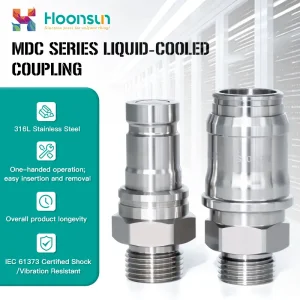
As mega-watt fast charging (MCS) and hyperscale AI server clusters shift to direct-to-chip dielectric liquid cooling, our engineers are deploying dual-chamber connectors combining high-current copper pin terminations with high-seal aluminium fluid quick-disconnect couplings within a singular hermetic housing.
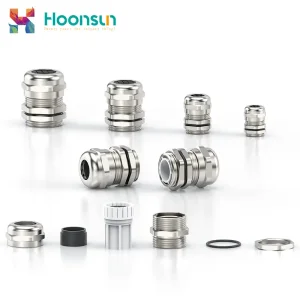
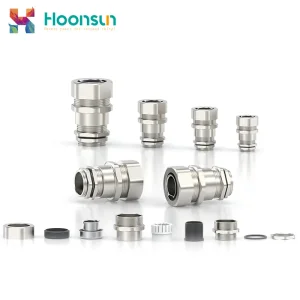
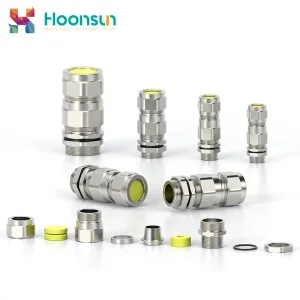
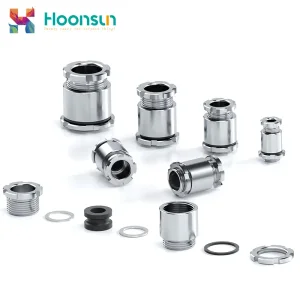
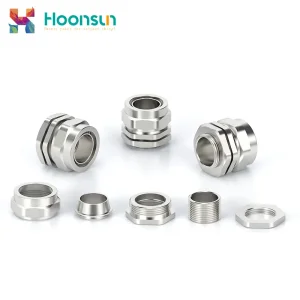
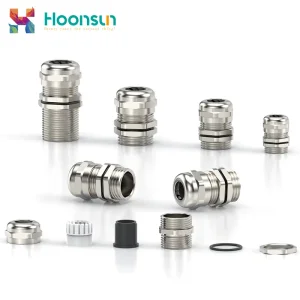
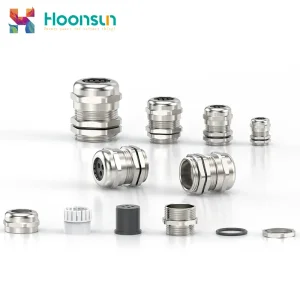
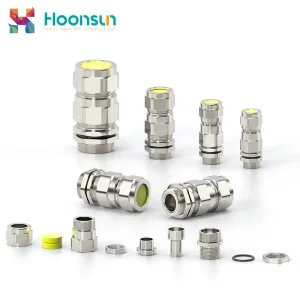
Specialized Ingress & Marine-Grade Terminations
Browse our extensive certified product catalog, engineered to prevent fluid, particulate, and explosive gas transmission across hazardous and heavy industrial zones.
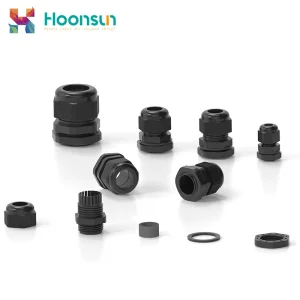
Global Compliance Assurance: Hydrostatic & Pull-Out Validation
Certified testing procedures conducted per part number in our ISO/IEC 17025 accredited laboratory facilities.
IP68 Hydrostatic & IP69K Steam Immersion
Sealing certification is verified through real continuous hydrostatic testing: 10 bar (100 meters submersion depth) for 14 continuous days per EN 60529. Additionally, samples endure 100 bar high-pressure water spray at 80°C (IP69K) to validate protection against localized washdowns in food-grade or mobile equipment.
Type A / Type B Cable Retention (UL 514B)
Under tension test protocols, our engineered mechanical clamping collet grips the outer jacket with an axial holding force exceeding 450 N without cutting into the insulating jacket or inducing internal conductor slippage, fully complying with both North American UL 514B and European EN 62444 pull-out classes.
Extreme Temperature & Salt Fog (ASTM B117)
Subjected to accelerated salt fog weathering chamber exposure exceeding 1,000 continuous hours without pitting or passivation rupture. Environmental cyclic aging tests confirm zero brittleness down to -40°C and sustained elastomer resilience at +120°C operational temperatures.
Frequently Asked Questions: Sourcing & Technical Specifications
Comprehensive engineering clarifications addressing alloy performance, galvanic mitigation, OEM customization, and certification auditing.