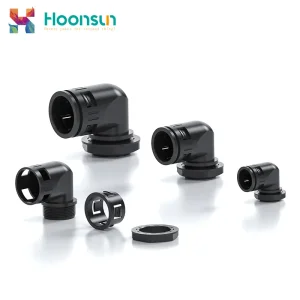
High-Performance Cable Glands & Connectors
Engineered to ensure zero failure in critical sealing, explosive atmospheres, and liquid-cooling architectures.
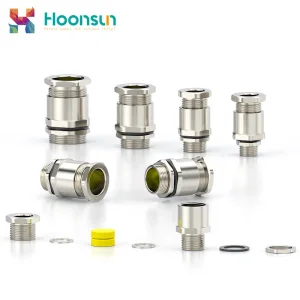
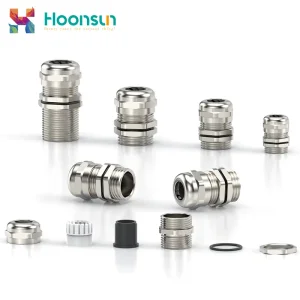
Engineering Excellence & Supply Chain Resilience
A technical examination of Chinese advanced precision manufacturing within mission-critical power, data, and fluid connectivity ecosystems.
Agglomeration & Metallurgy Control
Situated in China's leading electromechanical cluster (Yueqing/Wenzhou), our facilities leverage fully integrated vertical supply chains. From in-house bar turning and cold heading to automated CNC precision-threading, our operations eliminate tier-2 sourcing delays while maintaining traceably pure brass (HPb59-1), SUS304/316L, and UL94-V0 virgin PA66 polyamide.
Automated Quality Assurance
Deploying automated multi-axis visual inspection systems and continuous thread-pitch gauging, we prevent micro-defects before packaging. Critical parameters such as IP68/IP69K sealing pressures, ingress barriers, cable strain pull-out thresholds (EN 62444), and flame resistance meet global third-party testing parameters without batch divergence.
Geographic Trade Optimization
Integrated ERP with sea-rail intermodal freight routes via Ningbo and Shanghai ports enables expedited delivery to global distribution hubs across North America, the European Union, Southeast Asia, and the Middle East, maintaining robust inventory cycles for large-scale engineering contractors.
Emerging Trends Shaping the Cable Gland Industry
How evolving connectivity demands, renewable megaprojects, and high-density electrification challenge legacy design standards.
EMI/RFI Shielding & 360° EMC Grounding
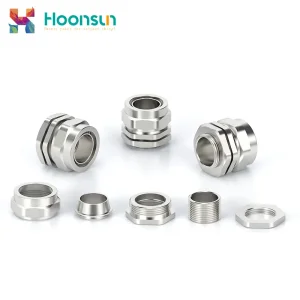
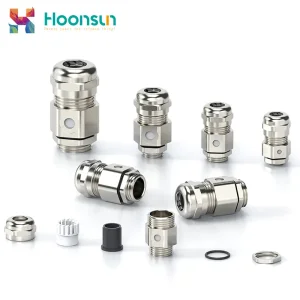
With variable-frequency drives (VFDs), industrial IoT transceivers, and electric mobility drivetrains running in dense environments, traditional non-conductive cable glands invite severe data corruption. Modern shielded EMC glands feature phosphor bronze contact springs ensuring continuous 360° low-impedance earthing under dynamic mechanical stress.
Liquid Cooling & Fluid Hybrid Integration
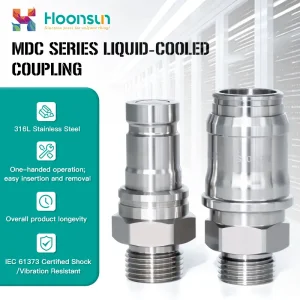
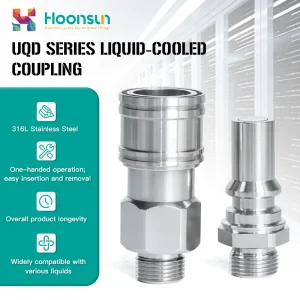
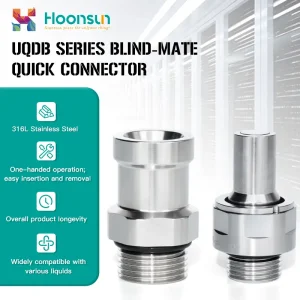
The explosion of high-density AI compute clusters, supercharging stations, and large-scale battery energy storage systems (BESS) has driven integration between electrical wire sealing and dripless quick-disconnect couplings (UQDB/MDC Series) to manage thermal loads in confined envelopes safely.
Active De-Aeration & Breathable Glands
Outdoor enclosures face extreme solar loading followed by rapid thermal collapse during storms, creating inner vacuum forces that draw moisture past conventional seals. Integrated breathable ePTFE membrane glands balance internal atmospheric differentials while maintaining hermetic IP68 liquid barriers.
Comprehensive Cable Gland Selection Framework
A reference table outlining material compatibility, temperature endurance, ingress integrity, and recommended operating sectors.
| Classification | Core Composition | Operating Temp | Ingress Rating | Shielding / Mechanical | Key Applications |
|---|---|---|---|---|---|
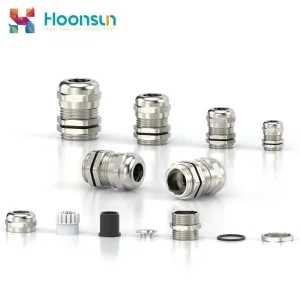
| Nickel-Plated Brass | CuZn39Pb3 / Nickel Plating | -40°C to +100°C | IP68 (5 Bar) | High Impact / Available EMC Spring | Industrial Automation, Heavy Machinery, VFD Drives |
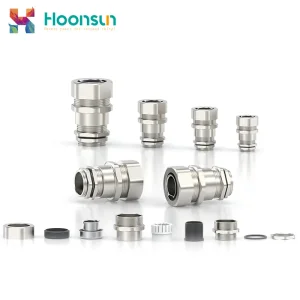
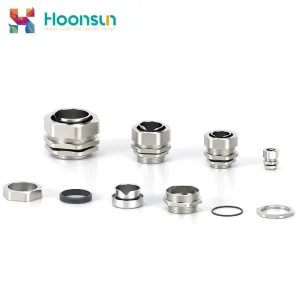
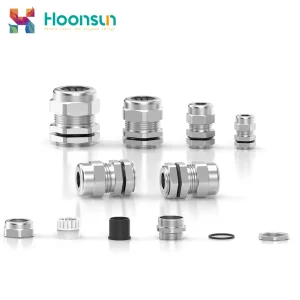
| Stainless Steel 316L | Marine Grade Austenitic Steel | -60°C to +180°C | IP68 / IP69K | Extreme Tensile, Acid/Salt Resistant | Offshore Platforms, Chemical Plants, Food & Beverage |
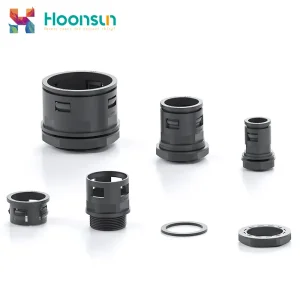
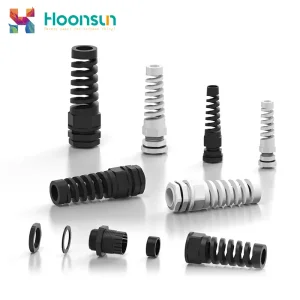
| Nylon Polyamide (PA66) | UL94 V-0 Virgin Resin | -40°C to +85°C | IP68 | Non-Conductive, Anti-Bending Spiral | Solar PV Inverters, Distribution Cabinets, Telecom |
| Hazardous / EX Armor (BW/CW) | Brass / Stainless Steel | -50°C to +120°C | IP66 / IP68 | Clamping Steel Wire Armor (SWA) | Oil & Gas Refineries, Underground Mining, Explosive Gas |
| Liquid Quick Connectors | Anodized Aluminum / Brass | -40°C to +120°C | Leak-Free Dry Break | Fluid Sealing for Coolants (Ethylene Glycol) | AI Server Racks, EV Battery Conditioning, Power Grids |
Mission-Critical Applications Worldwide
Field installations rely on our connectors and glands under extreme temperatures, mechanical stresses, and corrosive exposure.
Electric Mobility & Charging Infra
Megawatt charging networks and high-voltage vehicle junction boxes require robust mechanical strain relief, heat resistance, and ingress barriers against sub-chassis road wash, vibration, and automotive de-icing salts.
Offshore Wind & Marine Operations
Turbine nacelles and marine control nodes endure continuous salt spray, high humidity, and structural buffeting. Our specialized TJ-clamping and 316L cable glands prevent electrolytic degradation and internal moisture tracking.
Hyperscale Compute Thermal Systems
Modern data centers run closed-loop liquid cooling. Combining blind-mate dripless hydraulic couplings with vibration-resistant power entries guarantees zero-downtime performance for mission-critical rack systems.
What Global EPCs Look for in Cable Gland Manufacturers
Key audit checkpoints international purchasing officers prioritize during supplier qualification and factory inspection.
Thread Uniformity & Gaging
Metric (M), PG, NPT, and G (Gas/BSPP) threads must seat smoothly without galling. Top Chinese factories utilize optical non-contact profile projectors alongside GO/NO-GO precision plug gauges on every production lot.
Elastomer Composition & Compression
O-ring and clamping claw inserts (NBR, EPDM, Silicone, or Viton) define long-term lifecycle success. Buyers evaluate chemical resistance, ozone tolerance, and low compression set under wide temperature ranges.
Traceable Regulatory Paperwork
Tier-1 contractors require transparent documentation: material mill certificates (EN 10204 3.1), RoHS 2.0/REACH compliance files, salt-spray chamber test reports, and UL/IECEx safety certificates per part number.
Frequently Asked Technical Questions
Clear answers to engineering, selection, and manufacturing considerations for international buyers.
What is the difference between Metric (M) and NPT threads?
Metric threads (DIN EN 60423) feature parallel cylindrical threading measured in millimeters with a 1.5mm pitch, sealing with an external O-ring against the housing wall. NPT (National Pipe Taper) threads follow ANSI B1.20.1 and are tapered at 1°47', creating a seal through mechanical thread interference, commonly specified in North American energy installations.
How is EMC cable shielding grounded effectively inside a gland?
Standard EMC cable glands strip the outer jacket down to the braided wire. When tightened, an internal conical copper-beryllium spring pushes the braided shield evenly against the nickel-plated brass body, establishing a 360-degree, low-resistance ground path that shunts high-frequency noise directly into the chassis.
When should 316L stainless steel be chosen over nickel-plated brass?
While nickel-plated brass provides reliable mechanical strength and corrosion protection in general manufacturing, marine environments with high salt mist, acidic washdowns in food plants, and offshore rigs require austenitic SS316L (with 2-3% molybdenum) to prevent pitting corrosion.
Can custom thread lengths and special clamping inserts be engineered?
Yes. As an original equipment manufacturer (OEM), our Yueqing machining center can lengthen entry threads for thick cast-aluminum junction boxes, adapt multi-hole rubber seals for multiple signal cables, or incorporate Viton seals for sustained temperatures up to +200°C.
Explore Additional Connectivity Solutions
Armored BW/CW cables, flexible hose couplings, stainless glands, and quick-disconnect fittings.