Production Lineup - Phase 01
Engineered Industrial Cable Gland Solutions
Factory-direct high-retention glands designed for rigorous dimensional conformance, extreme dynamic pull-out resistance, and certified environmental protection.
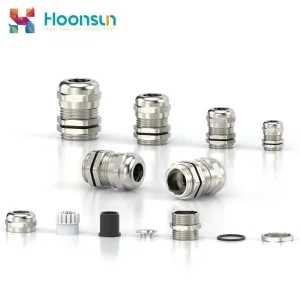
China IP68 Waterproof Metal Shielded Cable Joint - UL Listed
Explore Specifications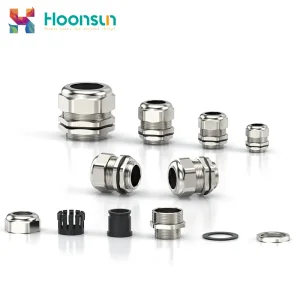
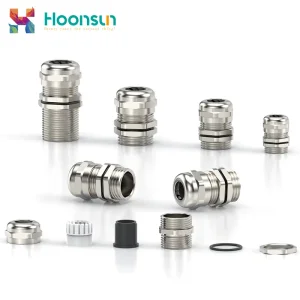
China Metal Cable Gland Strengthened Type - UL Certified IP68
Explore Specifications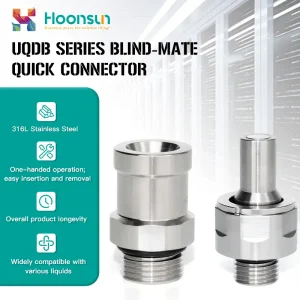
China UQDB04S-1SMU082N-UQDB04P-1SMU062N Manufacturers
Explore Specifications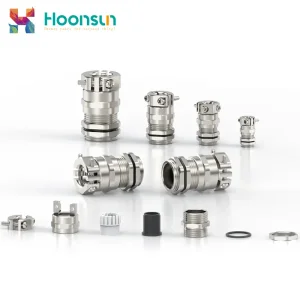
China Metal Cable Gland Double Lock Type IP68
Explore Specifications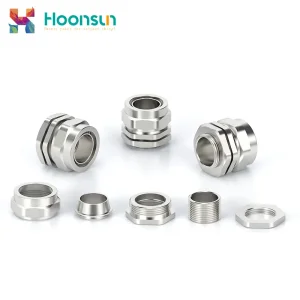
China BW Cable Gland with Waterproof IP68 and UL
Explore Specifications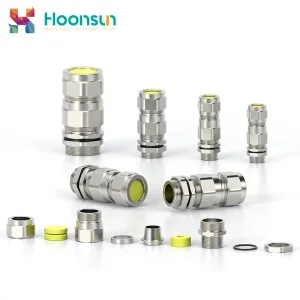
China Explosion-Proof Cable Clamp Sealing Joint EX5
Explore Specifications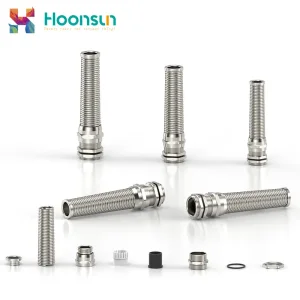
China Metal Anti-Bending Cable Gland IP68 UL
Explore Specifications
Industry Whitepaper Foundation
The Paradigm Shift in Cable Gland Sizing Calculations
Navigating the transition from rule-of-thumb selection to algorithmic multi-variable sizing calculation models across modern automation, hyperscale energy storage, and marine environments.
2006est.
Pioneering Year in Liushi, Yueqing
100%
Lot-by-Lot Pre-Shipment Inspection
5Bar
Standard Submersible Hydrostatic Rating
800+
Global Tier-1 EPC & OEM Partners
Cable Outer Diameter (OD) Variance vs Sealing Margin
Modern industrial cables manufactured under international standards (such as IEC 60502 or BS 5467) feature permissible batch manufacturing tolerances of ±5% to ±10% on external jacket thickness. Relying strictly on "nominal" ODs without rigorous mathematical size calculations leads to either elastomer extrusion under excessive torque or catastrophic ingress leakage due to under-clamping.
Our factory engineering protocol incorporates Dynamic Radial Displacement Equations to verify that the elastomer seal maintains constant IP68 hydraulic contact pressure even under thermal cycling from -40°C to +120°C.
Armour Clamping & Earth Fault Current Density
For steel wire armoured (SWA) and steel tape armoured (STA) cables, sizing calculations extend beyond outer diameter retention to mechanical cone grip geometry and short-circuit withstand. Sizing incorrect glands risks crushing internal conductors or failing low-impedance earth fault continuity under catastrophic grid transients.
- Calculated cone angle matching armour wire thickness (0.9mm to 2.5mm SWA).
- Mechanical pull-out retention calculated to exceed IEC 62444 Class B requirements (>450 N).
- Earth fault path tested up to 43kA for 1 second without terminal deformation.
Electromagnetic Compatibility (EMC) 360° Shielding
With variable frequency drives (VFDs) and high-power density converters dominating industrial automation and EV charging hubs, high-frequency common-mode noise requires low-transfer impedance cable gland designs. Size calculation must accurately reflect the cable braided shield diameter prior to flare-out.
HOONSUN EMC glands utilize phosphor bronze or beryllium copper contact springs engineered to establish continuous 360-degree grounding contact without manual braid pigtailing, preserving system attenuation down to <10 mΩ/m at 100 MHz.
Precision Engineering Formulation
Algorithmic Cable Gland Sizing Methodology
Step-by-step mathematical criteria for selecting thread pitch, inner sealing grommet displacement, enclosure wall engagement, and dynamic mechanical torque retention.
The Universal Gland Sizing Formulation (IEC 62444 & UL 514B Conformance)
To ensure IP68 submersible integrity without cold flow deformation of the outer PVC/LSOH/XLPE sheathing, the gland entry bore diameter ($D_g$), seal inner diameter ($d_s$), and uncompressed cable outer diameter ($D_c$) must satisfy the continuous boundary equilibrium:
$D_{c\_min} \le d_s \le D_{c\_max}$ and $C_r = \frac{A_u - A_c}{A_u} \times 100\% \in [18\%, 32\%]$
Where $C_r$ represents the volumetric elastomeric compression ratio, $A_u$ is uncompressed cross-sectional area, and $A_c$ represents compressed inner volume under recommended assembly torque ($\tau_n$).
| Metric / PG Thread Designation | Cutout Bore Clearance (mm) | Clamping Range (Cable OD Min-Max mm) | Recommended Body Torque (Nm) | Cap Nut Assembly Torque (Nm) | Ingress Protection Rating | Standard Material Composition |
|---|---|---|---|---|---|---|
| M12 × 1.5 | 12.2 - 12.4 | 3.0 - 6.5 mm | 3.5 - 5.0 Nm | 2.5 - 3.5 Nm | IP68 / 5 Bar | Nickel-Plated Brass / PA66 / NBR |
| M16 × 1.5 | 16.2 - 16.5 | 4.0 - 8.0 mm | 6.0 - 7.5 Nm | 4.5 - 5.5 Nm | IP68 / 5 Bar | Nickel-Plated Brass / 304 / 316L |
| M20 × 1.5 (Standard) | 20.3 - 20.6 | 6.0 - 12.0 mm | 9.0 - 11.0 Nm | 7.5 - 9.0 Nm | IP68 / 5 Bar | Nickel-Plated Brass / PA66 / Silicone |
| M25 × 1.5 | 25.4 - 25.7 | 10.0 - 14.0 mm | 12.0 - 15.0 Nm | 10.0 - 12.5 Nm | IP68 / 10 Bar | Nickel-Plated Brass / 316L Stainless |
| M32 × 1.5 | 32.4 - 32.8 | 15.0 - 22.0 mm | 18.0 - 22.0 Nm | 15.0 - 18.0 Nm | IP68 / 10 Bar | Nickel-Plated Brass / EPDM / FKM |
| M40 × 1.5 | 40.4 - 40.8 | 19.0 - 28.0 mm | 25.0 - 30.0 Nm | 20.0 - 25.0 Nm | IP68 / 10 Bar | HPb59-1 Brass / Marine Bronze |
| M50 × 1.5 | 50.5 - 51.0 | 27.0 - 35.0 mm | 35.0 - 42.0 Nm | 30.0 - 35.0 Nm | IP68 / 10 Bar | Nickel-Plated Brass / 316L Stainless |
| M63 × 1.5 | 63.6 - 64.2 | 34.0 - 45.0 mm | 45.0 - 55.0 Nm | 38.0 - 48.0 Nm | IP68 / 10 Bar | 316L Marine Stainless / Brass |
| PG7 (DIN 40430) | 12.8 - 13.0 | 3.0 - 6.5 mm | 3.5 - 4.5 Nm | 2.5 - 3.5 Nm | IP68 | PA66 Polyamide / Nickel Brass |
| PG11 | 18.8 - 19.1 | 5.0 - 10.0 mm | 7.0 - 8.5 Nm | 5.5 - 6.5 Nm | IP68 | PA66 Polyamide / Nickel Brass |
| PG21 | 28.5 - 28.9 | 13.0 - 18.0 mm | 14.0 - 17.0 Nm | 12.0 - 14.5 Nm | IP68 | Nickel-Plated Brass / EPDM |
| NPT 1/2" (ANSI B1.20.1) | 21.2 - 21.5 | 6.0 - 12.0 mm | 12.0 - 16.0 Nm | 10.0 - 13.0 Nm | NEMA 4X / IP68 | Brass / 316L Stainless Steel |
Sector Sizing Architectures
Macro Industry Solutions & Engineered Blueprints
Every industry enforces distinct boundary constraints on cable gland sizing. From battery energy storage systems (BESS) to deep-sea maritime drilling, our engineering team standardizes custom thread, profile, and sealing geometries.
Energy Storage & Electric Vehicles
Thermal cycling inside liquid-cooled battery packs and high-voltage distribution units (HVDUs) causes severe expansion and contraction of silicone elastomer seals. Our custom sized gland assemblies integrate fluid seals tested to maintain zero dielectric breakdown across 1500V DC operating voltages.
- Elimination of cold creep on flexible braided copper cables.
- Shield termination with attenuation >65dB at 30MHz-1GHz.
- High-retention anti-vibration locknuts resisting ISO 16750-3 vibration profiles.
Marine, Offshore & Subsea Platforms
Marine applications mandate salt-fog corrosion immunity and non-hygroscopic elastomeric inserts. We machine our marine series from CW614N/CW617N nickel-plated brass and AISI 316L austenitic stainless steel, incorporating double O-ring thread seals to prevent galvanic bridge degradation across switchboard panels.
- TJ Clamping and TH standard configurations for braided shipboard wire.
- Lloyd's Register & DNV compliant hydrostatic resistance up to 20 Bar.
- Halogen-free, flame-retardant clamping rings exceeding IEC 60092-352.
Hazardous Areas (Ex d / Ex e Flameproof)
Within petrochemical refineries, hydrogen production facilities, and mining switchgear, calculation errors in explosion-proof cable entries present severe ignition hazards. Our EX-certified double-lock glands feature precision-threaded flame paths designed to quench internal explosions without propagating flame fronts.
- Compliance with IECEx and ATEX directives under EN 60079-0/1/7.
- Calibrated barrier compound calculation matrices for irregular conductor voids.
- Gas group IIA, IIB, IIC and Dust group IIIA, IIIB, IIIC full coverage.
Direct Manufacturing Infrastructure
Precision Factory Manufacturing & Quality Architecture
Operating from our modern manufacturing base in Shenhe Village, Liushi Town, Yueqing City — the world's epicenter of low-voltage electrical apparatus — Zhejiang Hongxiang Connector Co., Ltd. (HOONSUN) delivers end-to-end quality sovereignty.
High-Precision CNC Multi-Axis Machining
Unlike trading intermediaries, our factory floor houses high-precision CNC multi-spindle automatic lathes that turn gland bodies, locknuts, and entry cones within ±0.015mm dimensional tolerances. This ensures pitch thread engagement that eliminates galling on stainless steel entries and guarantees IP68 hermetic sealing.
In-House Environmental & IP Testing Labs
Every cable gland batch undergoes non-destructive optical measurement, salt spray fog testing (exceeding ASTM B117 720 hours for nickel brass and 1000 hours for 316L), tensile pull-out verification, and IPX8 immersion testing inside computerized pressurized water vessels to 0.5-1.0 MPa.
Rapid OEM/ODM Engineering Turnaround
With an engineering team dedicated to customized thread conversions (Metric to NPT, PG to BSPP, extended thread entry lengths for thick enclosure walls), HOONSUN turns custom 3D CAD models into rapid functional prototypes within 5 business days, supported by complete material test reports (MTR).
Forward Horizon
Technology Roadmap: Intelligent Sizing & Next-Gen Materials
The convergence of industrial automation, artificial intelligence, and liquid cooling is redefining the basic architecture of cable entries through 2035.
AI Digital Twin Sizing Engines
HOONSUN is deploying web-based and CAD-integrated algorithmic calculators that ingest 3D wire harness routing geometry, ambient thermal gradients, dynamic vibration vectors, and chemical exposure risks to automatically output the optimal gland part number and torque window, eliminating human calculation error in megaproject engineering.
Self-Healing Nanocomposite Elastomers
Collaborating with polymer research institutions, we are formulating specialized fluorosilicone and fluoroelastomer sealing inserts enriched with micro-encapsulated siloxane polymers. In the event of mechanical abrasion or ozone micro-fissuring, the elastomer self-heals under atmospheric moisture, guaranteeing 30-year maintenance-free service lives.
Liquid Cooling & Hybrid Data Center Connectors
With artificial intelligence clusters drawing unprecedented thermal loads, modern enclosures require simultaneous routing of 48V/400V busbar conduits alongside blind-mate liquid cooling quick couplings. Our UQD and MBD series integrate stainless steel non-spill hydraulic shutoffs directly adjacent to sealed high-amperage gland terminals.
Engineering Verification
Frequently Asked Questions: Cable Gland Size Calculation
Authoritative answers to the most critical mechanical sizing, thermal expansion, thread adaptation, and compliance questions faced by electrical engineers and procurement directors.
How do you accurately calculate the clamping range for irregular or out-of-round cables?
Cables with multicore twisted conductors often exhibit an oval or non-circular jacket geometry. When sizing a cable gland, you must never calculate using only the major or minor axis. The effective diameter ($D_{eff}$) should be derived using calibrated vernier calipers taking the average: $D_{eff} = \frac{D_{major} + D_{minor}}{2}$. To guarantee an IP68 seal, the gland's minimum clamping diameter must sit at least 1.0mm below the measured $D_{minor}$, ensuring the elastomeric seal compresses uniformly around the entire circumference before the cap nut bottoms out.
What is the engineering difference between Metric, PG, and NPT thread calculations?
Metric threads (M per ISO 68-1 / EN 60423) feature a straight cylindrical 60° thread angle with a standard 1.5mm pitch across most industrial glands, sealing primarily against the face using an elastomeric O-ring or flat washer. PG threads (DIN 40430) feature an 80° flank angle and shorter thread depth, historically popular in European switchboards. In contrast, NPT threads (ANSI/ASME B1.20.1) are tapered at 1°47′ (3/4" taper per foot), relying on mechanical flank wedging and anaerobic thread sealant for pressure sealing. Sizing must calculate not just nominal diameter, but enclosure wall thickness and tapped thread depth to achieve full thread engagement (minimum 5 full threads for explosion-proof applications).
How does thermal cycling affect the torque calculation on PA66 nylon cable glands?
Polyamide PA66 exhibits a coefficient of thermal expansion ($\alpha \approx 80 \times 10^{-6} K^{-1}$) significantly higher than brass ($\alpha \approx 19 \times 10^{-6} K^{-1}$) or copper conductors. In outdoor solar inverters or sub-zero refrigeration environments, rapid temperature shifts cause relaxation of unreinforced nylon cap nuts. Sizing calculations for plastic glands in demanding environments must specify glass-filled PA66 (15-30% GF) and incorporate ratchet-style lock teeth on the cap nut dome to prevent mechanical vibration back-off while remaining within the allowable elastic shear limits.
What sizing criteria are mandatory for Steel Wire Armoured (SWA) cables?
SWA cables require a multi-part cable gland (e.g., BW or CW types). Sizing calculation requires three discrete dimensions: (1) Diameter Under Armour / Bedding OD to match the inner sealing ring and cone entry; (2) Armour Wire Gauge (diameter of individual galvanized steel wires, typically ranging from 0.9mm to 2.5mm) to select the correct cone and clamping ring taper angle; and (3) Overall Cable Jacket OD to size the outer compression seal that prevents moisture ingress into the armour layer.
Why does over-torquing a cable gland cause long-term waterproofing failure?
Applying torque beyond the factory-recommended Nm specification causes a severe phenomenon known as elastomeric extrusion and cable cold flow. Under excessive compressive stress, the rubber grommet flows longitudinally rather than exerting radial clamping pressure, permanently distorting or cutting through the cable's protective outer jacket. Over months of thermal cycling, the plasticized sheath relaxes, leaving an annular gap between the relaxed seal and cable jacket that permits capillary water siphonage. Strictly adhering to calibrated torque charts is mandatory for IP68 longevity.
Production Lineup - Phase 02
Heavy-Duty & Specialized Industrial Entries
Marine TJ/TH series, multi-hole cable pass-throughs, quick-connect liquid cooling couplers, and explosion-proof terminal joints manufactured directly by HOONSUN.
China Metal Cable Gland Double Lock Type IP68 Harsh Environments
Explore Specifications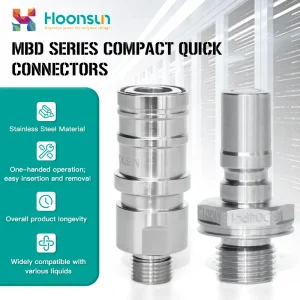
China MBD04S-1SMG012N-MBD04P-1SMG012N Supplier
Explore Specifications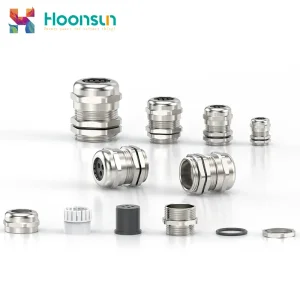
China Durable Metal Multi-Hole Cable Gland IP68 UL
Explore Specifications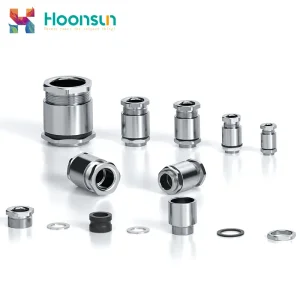
China IP68 Marine Cable Gland TJ Clamping Type UL
Explore Specifications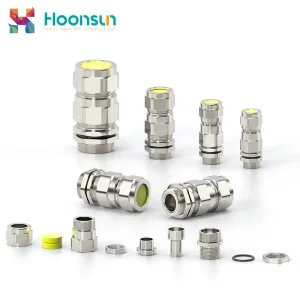
China IP68 Explosion-Proof Cable Clamp Sealing Joint EX3
Explore Specifications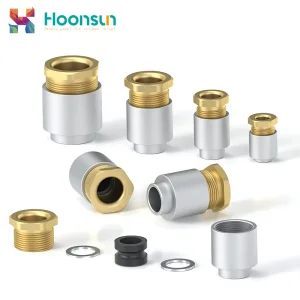
China IP68 Marine Cable Gland TH Standard Type
Explore Specifications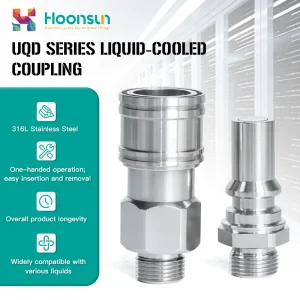
China High-Performance Liquid-Cooled Quick Coupling UQD
Explore Specifications