
Certified Product Lines
Engineered Compression Termination Portfolio (Batch I)
Direct supply from state-of-the-art Yueqing manufacturing facilities with complete batch traceability, certified IP68 ingress integrity, and global compliance testing.
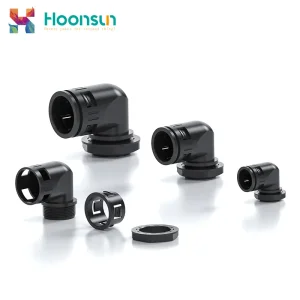
Right Angle Union for Flexible Pipe - IP68 Waterproof, UL Certified
Explore Product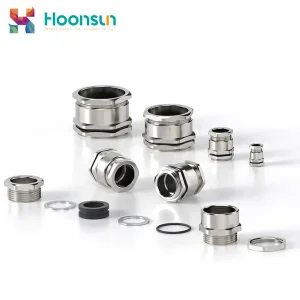
Single Compression Type Cable Gland IP68 Rated for Marine Applications
Explore Product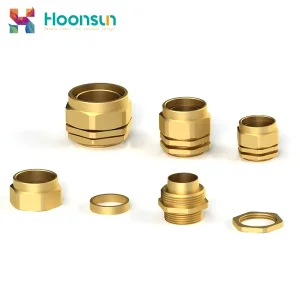
BWL Cable Gland Designed to Meet IP68 and UL Specifications
Explore Product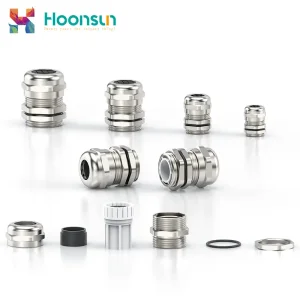
Metal Cable Gland Direct Type with IP68 and UL Certifications
Explore Product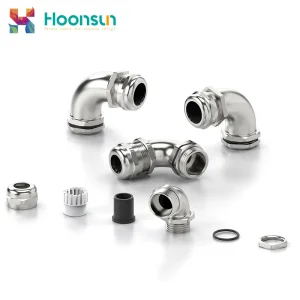
IP68 Right Angle 90° Cable Gland - Corrosion-Resistant Cable Management
Explore Product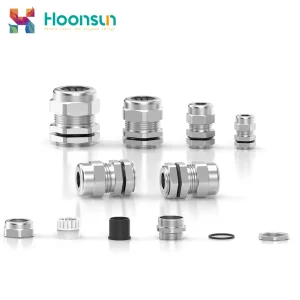
Stainless Steel Cable Gland - IP68 Waterproof, UL Certified Factory Direct
Explore Product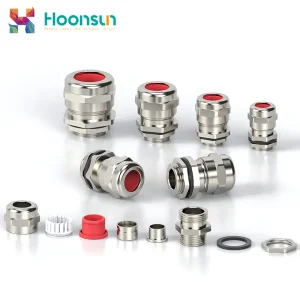
Simple Armored Cable Gland - Dual IP68 & UL Certified Protection
Explore Product
Global Market Architecture
Worldwide Industrial Status of Advanced PVC & Compression Glands
Analyzing cross-continental demand across North American, European, and Asia-Pacific utility, commercial, and extreme-environment installations.
Decarbonization & Grid Electrification
Global investments in photovoltaic fields, utility-scale Energy Storage Systems (BESS), and offshore wind energy have amplified demand for non-conductive, chemically inert cable gland solutions. Modern PVC, PA66 nylon, and nickel-plated hybrid compression fittings protect sensitive high-voltage DC circuits against volatile ambient conditions without electrolytic galvanic degradation.
Designers prioritize UV-stabilized rigid PVC and halogen-free polymer glands capable of resisting thermal degradation between -40°C and +105°C, establishing reliable seal barriers across decades of continuous exposure.
Macro Procurement Economics
Global supply chain directors within EPC contracting firms have shifted purchasing vectors away from regionally localized, high-markup traders. Instead, they increasingly establish direct-to-factory supply lanes with top-tier Chinese manufacturers.
This structural recalibration minimizes intermediary logistical overhead while ensuring direct access to customized molds, private label OEM packaging, and standardized thread conversions (Metric, NPT, PG, G) on single multi-container consignments.
Ingress & Hazard Regulatory Strictures
Modern electrical enclosures demand verified compliance with strict international codes, including EN 62444 for strain relief and retention, IEC 60529 for ingress barrier defense (IP66, IP67, IP68 5 bar), and UL 514B for metallic/non-metallic conduit and cable fittings.
Compression glands must dynamically compensate for cable sheathing thermal expansion and contraction cycles under heavy load currents, eliminating micro-gap formations that lead to moisture capillary suction.
99.8%
First-Pass Yield Ratio via Automated Precision Tooling
5.0 Bar
Submersible Hydrostatic Pressure Proof (IP68 Standard)
120+
Export Sovereign Destinations Across 5 Continents
20+ Yrs
Manufacturing Expertise in Yueqing Industrial Cluster
Supply Chain Dominance
Chinese Factory Efficiency & The Yueqing Electrical Ecosystem
Why China's consolidated industrial clusters deliver unparalleled technical tolerance, material optimization, and mass-scale economies of scale.
Cluster Density & Vertical Raw Material Sourcing
Situated within Liushi Town, Yueqing—widely recognized as China's electrical hardware epicenter—manufacturers like HOONSUN operate inside a hyper-integrated vertical supply network. Polymer resins (modified PVC, polyamide PA66), metallurgical alloys (HPb59-1 brass, SS304/SS316L), and elastomeric seals (EPDM, NBR, silicone) are procured within a sub-50km radius.
This geographical consolidation reduces tooling turnaround, mitigates upstream transportation carbon expenditure, and compresses standard prototyping timelines from months into days.
High-Precision Multi-Cavity Injection & CNC Machining
Chinese production lines utilize synchronized robotics, high-speed computerized injection mold machines, and multi-spindle automatic CNC machining stations. Tight thread tolerances (6g/6H standard) are consistently achieved across high-volume production runs.
Every compression gland claw, locking nut, body core, and washer is checked with automated optical coordinate measurement systems, guaranteeing uniform wall thickness and eliminating weak fracture lines under heavy tightening torque.
Engineering Agility & Scalable OEM Adaptability
Unlike rigid Western production paradigms constrained by prohibitive tooling overheads, Chinese manufacturing plants excel at low-friction custom engineering. Whether clients require widened cable clamping ranges, specialized chloroprene rubber inserts for harsh oil contact, or custom thread pitch angles, Chinese factories adapt rapidly.
With an engineering team of over 80 specialized technical workers, manufacturing hubs offer transparent CAD/SolidWorks design turnarounds, providing sample verification within 48 to 72 hours.
Field Deployment
Comprehensive Industrial Application Scenarios
Real-world integration protocols: protecting electrical distribution nodes under extreme vibration, thermal swings, chemical exposure, and moisture ingress.
Solar Inverters & EV Charging Station Infrastructure
Commercial-grade DC combiner boxes and fast-charging DC dispensers experience severe seasonal thermal cycling and constant direct sunlight. PVC and nylon compression glands with enhanced UV inhibitors provide long-term resistance to embrittlement, stress cracking, and dielectric breakdown.
Precision-compressed NBR/silicone sealing rings grip unarmored PV cables firmly, neutralizing capillary moisture ingress even under sustained monsoon rains and low-pressure jet cleaning.
Marine, Offshore & Coastal Water Treatment Facilities
Saline atmospheres and aggressive chemical mist destroy inferior metal junctions via galvanic and pitting corrosion. High-impact PVC and 316L stainless steel compression glands offer dependable protection in desalinization plants, dock cranes, and onboard auxiliary systems.
Equipped with dual-seal barriers, these glands preserve IP68 waterproof ratings even under continuous hydrostatic submersion up to 50 meters water head depth.
Industrial Automation & Robotic Flex-Joint Cabling
Repetitive torsional twisting and rapid multi-axis gantry acceleration place heavy mechanical stress on cable junctions. Dynamic PVC and nickel-plated flexible hose glands feature internal multi-split claws that distribute retention forces evenly around conductors.
This prevents pinching, insulation abrasion, and conductor severing, meeting Type A cable pull-out ratings without crushing sensitive internal signal and fiber optic cores.
Technical Whitepaper
Material Engineering & Operational Capability Matrix
A reference guide for plant electrical engineers, systems integrators, and procurement officers selecting optimal gland substrates.
| Substrate Material | Tensile Strength | Operating Temp | Ingress Rating | Chemical / UV Resistance | Ideal Application Environment |
|---|---|---|---|---|---|
| Rigid PVC (Modified) | 45 – 55 MPa | -20°C to +70°C | IP66 / IP67 | Exceptional resistance to acids, alkalis, salts | Chemical dosing cabinets, outdoor raceways, municipal drainage |
| Polyamide PA66 (UL 94 V-2 / V-0) | 75 – 85 MPa | -40°C to +100°C | IP68 (5 Bar) | Resistant to fuels, greases, synthetic oils, UV stabilized | Solar power arrays, commercial HVAC, external control junction boxes |
| Nickel-Plated Brass (HPb59-1) | ≥ 390 MPa | -40°C to +120°C | IP68 / IP69K | High mechanical wear tolerance, good atmospheric defense | Heavy automation machinery, mining gear, motor terminal boxes |
| Stainless Steel (AISI 304 / 316L) | ≥ 520 MPa | -50°C to +200°C | IP68 / IP69K | Maximum resistance to chlorides, marine salt spray, caustic washdowns | Offshore oil & gas rigs, food & dairy processing, pharmaceutical cleanrooms |
| Explosion-Proof Armored Brass | ≥ 440 MPa | -40°C to +110°C | Ex d IIC / IP68 | Internal flame quench pathways, severe impact absorption | Hazardous classified zones (ATEX / IECEx Zone 1, Zone 2, Zone 21) |
Future Forecast
Industry Evolution & Strategic Global Sourcing Trends
Market developments shaping supply chain contracts, regulatory milestones, and technical specifications through 2030.
Sustainable Bio-Polymers & RoHS/REACH Audits
International environmental mandates demand full supply chain transparency. Tier-one Chinese manufacturers are leading this shift by moving away from legacy plasticizers and heavy metals, adopting lead-free brass formulations and fully compliant halogen-free, recyclable technical polymers.
Third-party testing via SGS and TÜV Rheinland confirms that zero hazardous off-gassing occurs even in high-heat enclosed cabinet environments, ensuring direct compliance with European RoHS 3 and REACH SVHC regulations.
Digitalized Vendor Portals & Direct Factory Audits
Leading global buyers now use hybrid audit processes. Using high-definition live streaming, digital coordinate measurements, and certified material test reports (MTRs), international project managers verify factory floors in real time without high travel costs.
This allows rapid vendor qualification, standardizes lot-traceability numbering on gland outer collars, and speeds up product delivery for large EPC operations.
Convergence of High-Speed Automation & Smart Tooling
Factories are rapidly adopting smart automated tooling for multi-step gland production. Automated assembly machines fit inner elastomeric sealing sleeves, insert retention lock-rings, and thread cap-nuts with calibrated digital torque precision in a single continuous process.
This automated flow prevents human assembly errors, protects sealing rings from micro-scratches, and delivers uniform, repeatable sealing performance across high-volume production orders.
Specialty Cable Glands
Engineered Compression Termination Portfolio (Batch II)
Heavy-duty, marine TJ-clamping, flexible metal conduit unions, and explosion-resistant fittings engineered for harsh industrial environments.
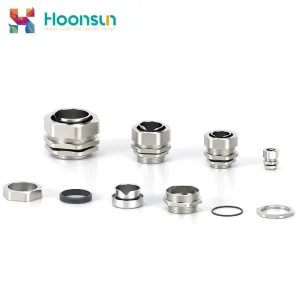
Nickel-Plated Brass Hose Cable Gland - Metal Hose Solutions
Explore Product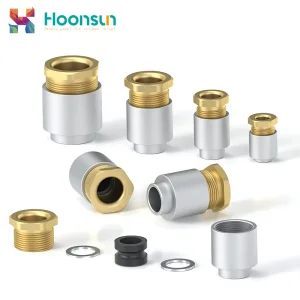
IP68 Marine Cable Gland TH Standard Type - Reliable Waterproof Solutions
Explore Product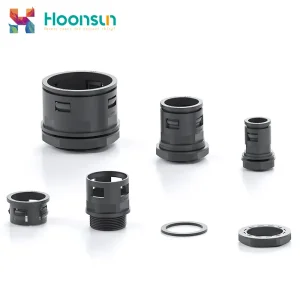
Nylon Union for Flexible Pipe - Durable IP68 Waterproof Connection
Explore Product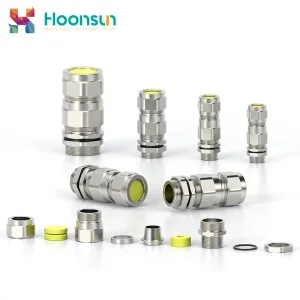
Explosion-Proof Cable Clamp Sealing Joint EX5 - IP68 & UL Certified
Explore Product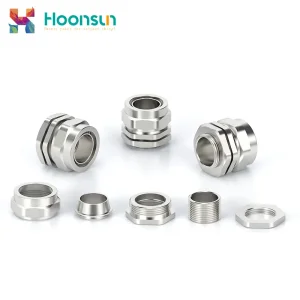
BW Cable Gland - Waterproof IP68, UL Certified, Explosion-Proof
Explore Product
Marine Cable Gland TH Standard Type - Factory-Direct IP68 Sealing
Explore Product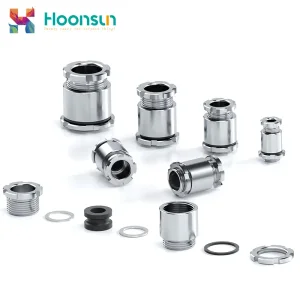
IP68 Marine Cable Gland JIS Standard Type - Certified for Offshore Use
Explore Product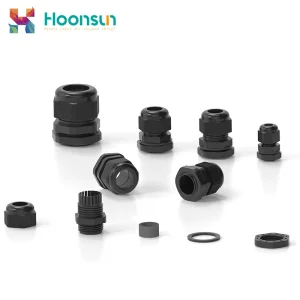
Nylon Cable Gland with IP68 and UL - Industrial Grade Compression
Explore Product
Procurement & Engineering Q&A
Frequently Asked Questions on Industrial Cable Glands
Authoritative technical answers to common questions asked by electrical engineers, EPC estimators, and quality compliance managers.
What are the key technical differences between PVC, PA66 Nylon, and Metal cable glands?
PVC (Polyvinyl Chloride) offers high resistance to acids, caustic alkalis, and inorganic salts at an economical cost point, making it well suited for chemical handling lines and standard commercial cable entries. PA66 Nylon provides higher tensile strength (75-85 MPa), a wider working temperature envelope (-40°C to +100°C), and superior dynamic strain relief for outdoor infrastructure like solar arrays and EV chargers. Metal Glands (Nickel-Plated Brass / Stainless Steel) deliver exceptional mechanical impact protection, complete electromagnetic compatibility (EMC) 360-degree shielding braid termination, and explosion containment compliance across ATEX/IECEx hazardous oil and gas environments.
How does IP68 verification work, and what determines long-term ingress protection?
Under IEC 60529 standards, an IP68 rating denotes that an assembly is completely dust-tight (6) and protected against continuous immersion in water under designated hydrostatic pressure heads (8). At HOONSUN facilities, baseline tests submerge assemblies under a 5-bar water pressure column (simulating a 50-meter depth) for 1 to 24 continuous hours.
Crucially, long-term field performance depends entirely on two factors: ensuring the cable sheath outside diameter (OD) sits cleanly within the manufacturer's specified clamping range, and tightening the outer compression dome nut to the recommended torque (Nm) using a calibrated wrench to prevent seal pinching or creep.
Which thread standard should be specified: Metric, PG, NPT, or G (BSPP)?
Selection depends directly on the destination region and enclosure entry specifications:
- Metric (M-threads): The global international standard (ISO 68-1 / EN 62444), utilizing a 1.5mm thread pitch across industrial automation, robotics, and European equipment.
- NPT (National Pipe Taper): The standard across North America (ANSI/ASME B1.20.1). Its 1° 47′ tapered thread walls form a mechanical pressure-tight seal along the thread spiral.
- PG (Panzergewinde): A legacy German electrical standard (DIN 40430) with shallower thread depths, still widely utilized worldwide in legacy replacement gear and machine tools.
- G (BSPP): British Standard Parallel Pipe, commonly chosen across Commonwealth regions for marine enclosures and fluid coupling applications.
What are the minimum order quantities (MOQ) and lead times for OEM private label orders?
Standard catalog line items maintained in export inventory are available for immediate dispatch without strict MOQs. For customized OEM private label manufacturing (involving custom color matching, custom thread lengths, private label box artwork, or laser-etched gland logos), standard pilot runs start at 1,000 to 5,000 pieces depending on part geometry.
Lead times for newly tooled mold designs average 15 to 20 business days, with regular full-container repeats shipping within 10 to 14 days from our Yueqing manufacturing hub.
How do Chinese factories maintain quality control and uniform dimensional tolerances across millions of units?
Modern Chinese tier-one manufacturers use a three-stage Total Quality Management (TQM) process under ISO 9001:2015 certification:
- Incoming Inspection (IQC): Raw polymer granules undergo melt flow index (MFI) and moisture analysis, while brass rods are checked for alloy composition using X-ray fluorescence (XRF) spectroscopy.
- In-Process Control (IPQC): High-precision CNC machines and robotic injection presses utilize automated optical coordinate systems, checking critical thread pitch, wall thickness, and claw flexure every 60 minutes.
- Final Quality Assurance (OQC): Random batch samples are pulled from every lot and subjected to destructive hydrostatic submersion (5 bar), pull-out tensile retention tests, and salt spray fog testing (exceeding 96-hour neutral salt spray criteria).