
High-Performance Armoured & Industrial Cable Glands
Explore UL-listed, IP68-certified, and ATEX-compliant cable entry solutions engineered for single-wire armoured (SWA), steel tape armoured (STA), and braided cables in harsh industrial installations.
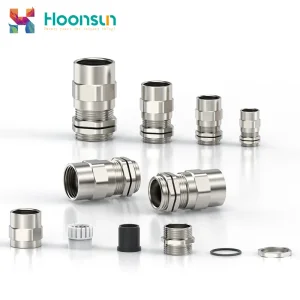
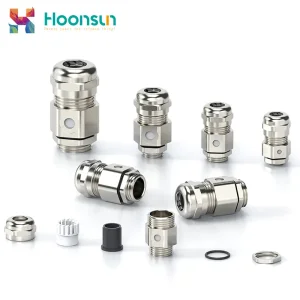
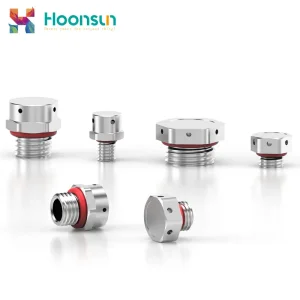
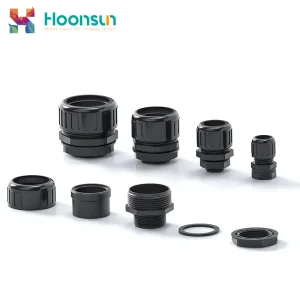
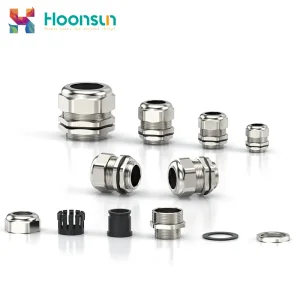
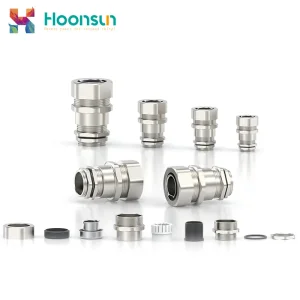
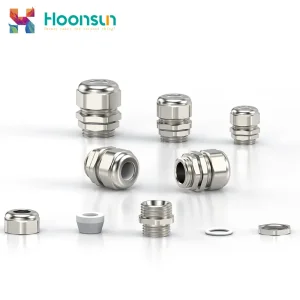
Global Armoured Cable Gland Engineering Architecture
A technical analysis of mechanical retention, earth continuity, ingress protection, and why standard sizing charts are critical to industrial plant integrity.
Mechanical Clamping Dynamics
Armoured cables—incorporating Single Wire Armour (SWA), Aluminium Wire Armour (AWA), or Steel Tape Armour (STA)—present severe mechanical termination challenges. An engineered gland must secure the armour wires between an internal cone and clamping ring with defined torque. This provides mechanical pull-out resistance exceeding IEC 62444 Class B standards (>1000 N pull-out force), preventing conductor strain during seismic shock or dynamic cable vibration.
Continuous Earth Fault Integrity
The armouring layer in high-voltage industrial circuits acts as a low-impedance earth fault return path. Inferior gland sizing causes high contact resistance, thermal hotspotting, and hazardous arc flash risk under short-circuit conditions. HOONSUN brass and stainless steel armoured glands are engineered with precise cone tapers to guarantee 360-degree circumferential contact, verified for short-circuit fault ratings up to 43kA for 1 second.
Dual Ingress Sealing Barriers
Unlike standard non-armoured glands featuring single compression rings, heavy-duty industrial armoured cable glands (such as CW, E1W, and E1WF configurations) utilize dual displacement seals. The inner elastomeric seal hydrostatically clamps against the cable inner bedding to prevent explosive gas or moisture migration, while the outer seal grips the cable outer sheath to guarantee continuous IP66, IP67, and IP68 (50m immersion for 30 days) performance.
Critical Engineering Note: Cold Flow Phenomemon in Armoured Cables
When selecting glands from a sizing chart, engineers must account for cold flow (creep) of thermoplastic inner sheaths (PVC/LSOH). Glands featuring displacement sealing or diaphragm sealing prevent premature compressive degradation under cyclic ambient temperatures (-40°C to +120°C). Standard compression seals, when torqued directly onto low-density bedding without mechanical travel limiters, cause internal bedding extrusion, leading to water egress paths and earth fault failures.
Comprehensive Armoured Cable Gland Sizing Reference Matrix
Standardized dimensional cross-reference covering Metric (EN 60423) and NPT (ANSI/ASME B1.20.1) entry threads, inner bedding diameters, outer sheath clamping ranges, and compatible wire armour gauges.
| Gland Size Reference | Metric Entry Thread (D1) | Alternative NPT Thread | Min Thread Length (mm) | Under Armour Bedding Dia (Max mm) | Overall Cable Outer Dia Min (mm) | Overall Cable Outer Dia Max (mm) | Armour Wire Acceptance (SWA mm) | Across Flats Hex (A/F mm) |
|---|---|---|---|---|---|---|---|---|
| BW / CW / E1W 20s | M20 × 1.5 | 1/2" NPT | 15.0 | 11.7 | 12.5 | 16.0 | 0.90 – 1.25 | 24.0 |
| BW / CW / E1W 20 | M20 × 1.5 | 1/2" NPT | 15.0 | 14.0 | 15.5 | 20.8 | 0.90 – 1.25 | 27.0 |
| BW / CW / E1W 25 | M25 × 1.5 | 3/4" NPT | 15.0 | 20.0 | 20.3 | 27.4 | 1.25 – 1.60 | 36.0 |
| BW / CW / E1W 32 | M32 × 1.5 | 1" NPT | 15.0 | 26.3 | 26.7 | 33.5 | 1.60 – 2.00 | 46.0 |
| BW / CW / E1W 40 | M40 × 1.5 | 1-1/4" NPT | 15.0 | 32.2 | 33.0 | 40.9 | 1.60 – 2.00 | 55.0 |
| BW / CW / E1W 50s | M50 × 1.5 | 1-1/2" NPT | 15.0 | 38.2 | 39.4 | 46.3 | 2.00 – 2.50 | 65.0 |
| BW / CW / E1W 50 | M50 × 1.5 | 2" NPT | 15.0 | 44.1 | 45.7 | 52.6 | 2.00 – 2.50 | 70.0 |
| BW / CW / E1W 63s | M63 × 1.5 | 2" NPT | 15.0 | 50.0 | 52.1 | 59.0 | 2.50 | 80.0 |
| BW / CW / E1W 63 | M63 × 1.5 | 2-1/2" NPT | 15.0 | 56.0 | 58.4 | 65.3 | 2.50 | 85.0 |
| BW / CW / E1W 75s | M75 × 1.5 | 2-1/2" NPT | 15.0 | 62.0 | 64.8 | 71.6 | 2.50 | 95.0 |
| BW / CW / E1W 75 | M75 × 1.5 | 3" NPT | 15.0 | 68.0 | 71.1 | 78.0 | 2.50 – 3.15 | 100.0 |
| Heavy Industrial 90 | M90 × 2.0 | 3-1/2" NPT | 20.0 | 80.0 | 77.0 | 88.0 | 3.15 | 115.0 |
Gland Designation: BW Type
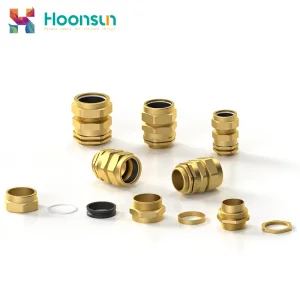
Configuration: Two-part brass gland without external sealing.
Primary Use: Dry indoor industrial plant enclosures where no water, dust, or corrosive vapours exist. Provides mechanical retention and earth fault continuity on single wire armour (SWA).
Gland Designation: CW Type
Configuration: Three-part brass gland with elastomeric outer sheath seal.
Primary Use: Outdoor and washdown applications (IP66). Clamps the armour wire securely for electrical earthing and seals the cable outer jacket against water ingress.
Gland Designation: E1W / E1WF Type
Configuration: Dual-compression system (inner seal + outer seal + armour cone).
Primary Use: Harsh marine, offshore, and ATEX/IECEx Zone 1/21 hazardous areas. Protects inner bedding from gas migration and seals out deep hydrostatic water pressures.
Why Sourcing from Yueqing Delivers Unmatched Global Competitiveness
Inside HOONSUN’s smart production facilities: The convergence of automated high-precision CNC machining, localized raw material supply networks, and strict aerospace-grade quality inspection.
Liushi Component Cluster Clustering
Situated in Liushi Town, Yueqing—widely recognized as China’s low-voltage electrical capital—HOONSUN benefits from an unmatched localized supply chain. Raw metallurgy suppliers (CW614N/CZ121 extruded brass rods, 304/316L stainless steel, EPDM/silicone elastomer compounds), toolmakers, electroplaters, and test houses operate within a 15-kilometer radius, slashing raw material procurement lead times by 65% compared to Western manufacturers.
High-Precision Multi-Axis CNC Turning
Our workshop floor houses high-precision Swiss-type multi-axis CNC lathes and dedicated automated thread-rolling machinery. Thread pitch, thread depth, internal chamfers, and armour clamping tapers are maintained within ISO 965 Class 6g/6H tolerances (±0.015mm). Unlike rough casting methods, continuous turning from solid bar stock ensures absolute structural density free from internal porosity, guaranteeing flameproof containment.
In-House 100% Quality Auditing
Every production batch undergoes a rigorous 5-stage verification protocol: Go/No-Go thread plug and ring gauge verification, salt spray corrosion testing (ASTM B117 up to 1000 hours), cable retention pull-out testing, dielectric insulation resistance screening, and pressurized hydrostatic immersion testing up to 10 bar (IP68 validation). Full 3.1 Mill Test Certificates are archived for complete heat traceability.
Engineered for Demanding Industrial Environments Worldwide
From deep-sea drilling platforms to Arctic wind farms, HOONSUN armoured cable glands provide verified environmental barrier protection across extreme operating conditions.
Offshore & Marine (FPSO / Wind)
Challenges: Heavy saline atmosphere, C5-M extreme marine corrosion, UV degradation, and green water deck washing.
Solution: Grade 316L stainless steel or nickel-plated marine brass E1W glands with silicone rubber seals, tested against deluge conditions according to DTS01 specifications.
Petrochemical & Refineries
Challenges: Flammable hydrocarbon gases (Zone 1 / Zone 2), aggressive solvents, hydrogen sulphide, high thermal swings.
Solution: Flameproof Ex d and Increased Safety Ex e dual-certified barrier glands that mechanically prevent flame transmission through cable interstices.
Underground Mining & TBM
Challenges: High mechanical crushing loads, dynamic vibrations, acidic slurry, abrasive dust.
Solution: Heavy-duty CW strengthened glands engineered with hardened internal clamping cones to withstand severe lateral impact forces without losing earth continuity.
Hyperscale Data Centers & BESS
Challenges: Electromagnetic interference (EMC), high current surges, zero-halogen environmental safety mandates.
Solution: 360° EMC-shielded brass glands with Low Smoke Zero Halogen (LSZH) elastomeric seals to isolate sensitive data buses from power harmonic distortion.
Enterprise Procurement Criteria & Future Engineering Trends
Key technical benchmarks for EPC procurement directors, panel builders, and international electrical wholesalers sourcing industrial cable glands from China.
Total Cost of Ownership (TCO) vs. Initial Unit Price
Procuring low-cost, uncertified cable glands frequently results in catastrophic field failures: seal embrittlement, galvanic corrosion between brass and aluminium armouring, and failure during annual thermographic infrared audits. Sourcing directly from verified high-tech manufacturers like HOONSUN delivers a 30%–45% direct procurement cost reduction against European brands while maintaining identical BS 6121 / EN 62444 engineering compliance, eliminating costly shutdown risks.
✓ Certified Nickel Plating Thickness (≥5μm for salt spray defense)
Emerging Trends: Smart Grids, Renewables & ESG Directives
The global transition to renewable microgrids and megawatt-scale battery energy storage systems (BESS) is transforming cable gland engineering. Current trends require flame-retardant polymers (UL94-V0), integration of pressure-compensation breathable membranes within gland bodies to prevent condensation, and halogen-free compounds compliant with RoHS 3 and REACH regulations to meet global ESG compliance audits.
◆ Low-Carbon Recycled Brass Alloys with <0.1% Lead Content
Specialized Industrial Enclosure & Hazardous Location Hardware
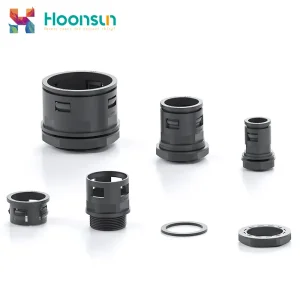
Complete your installation bill-of-materials with our factory-direct flexible conduit unions, explosion-proof joints, and specialized cable clamps.
Armoured Cable Gland Engineering FAQ
In-depth technical answers addressing sizing formulas, thread standards, earthing issues, and compliance protocols for electrical engineers and procurement teams.
How do you accurately calculate cable gland size using the sizing chart?
1. Inner Bedding Diameter (D_bed): For dual-seal glands (E1W, E1WF), ensure the maximum inner bedding diameter of the cable does not exceed the "Under Armour Bedding Dia Max" listed in the chart. If the bedding is oversized, the gland cone will not seat properly, crushing internal conductors.
2. Armour Wire Diameter (d_wire): Confirm that the cable's Single Wire Armour (SWA) or Steel Tape Armour (STA) gauge falls directly within the gland’s "Armour Wire Acceptance" range. Too thin an armour wire will slip under tension; too thick will prevent the clamping nut from fully engaging its threads.
3. Cable Overall Outer Diameter (OD): Ensure the measured outer diameter of the finished cable jacket sits comfortably between the "Overall Cable Outer Dia Min" and "Max" parameters so the outer elastomeric seal achieves 100% radial compression to meet IP68 sealing.
What is the difference between SWA and AWA cables, and can brass glands be used on both?
Crucial Rule: You cannot terminate single-core AWA cables using standard brass cable glands without precautions. Direct contact between brass (copper alloy) and aluminium wire in the presence of an electrolyte causes galvanic corrosion. For AWA cables, you must specify either dedicated aluminium cable glands or brass glands electro-plated with electroless nickel (minimum 10μm thickness) to isolate the metals.
When should an engineer specify CW versus E1W armoured cable glands?
• CW Glands: Feature a single external elastomeric sealing ring that seals against the outer cable sheath, with an internal cone securing the armour wires. Suitable for standard outdoor industrial applications where moisture protection is required only from the exterior.
• E1W Glands: Feature a dual-seal architecture—an inner displacement seal directly on the cable bedding layer, plus an outer seal on the outer jacket. E1W is required where the inner bedding must be sealed against gas migration, chemical intrusion, or deep subsea hydrostatic pressures, and is the standard for offshore marine and heavy petrochemical installations.
How does thread pitch and thread form affect enclosure entry compatibility?
What documentation and testing standards should accompany factory shipments?
Can HOONSUN manufacture customized thread lengths or non-standard metric pitches?
Request Direct Factory Sizing Verification & Project Quotes
Send your single-line electrical diagrams, cable datasheets, or enclosure entry specifications to our Yueqing engineering department. Our application team will return fully qualified part numbers, 2D/3D CAD models, test certificates, and volume FOB/CIF price schedules within 24 hours.