
Immediate Fleet Procurement
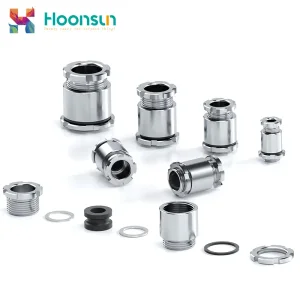
High-Spec Marine Gland Solutions Ready for Great Lakes Installation
Engineered for high mechanical retention, zero galvanic moisture entry, and certified ingress resistance under the demanding environmental cycles of Lake Ontario and the Port of Toronto.
Regional Strategic Analysis
Commercial Maritime Infrastructure in Greater Toronto & Lake Ontario
Analyzing the specialized engineering hurdles of Ontario's marine corridors: thermal cycling, freezing spray, lock vibration, and electrification transitions.
Port of Toronto Commercial Navigation
Handling over two million tonnes of cargo annually, PortsToronto manages deep-draft bulk freighters, tugboat operations, and passenger vessels along the Keating Channel and ship canal docks. Electrical routing through hull bulkheads, navigation consoles, and winch drives requires glands that endure steady mechanical vibrations and prevent liquid seepage into onboard control panels.
Lake Ontario Sub-Zero Thermal Cycling
Unlike warm-water equatorial shipping routes, the Toronto waterway experiences ambient shifts ranging from -30°C in winter ice conditions to +35°C during peak summer transit. Conventional polymer seals turn brittle and crack when exposed to sub-zero freeze-thaw cycles, creating capillary moisture paths. Our marine glands utilize custom-formulated Chloroprene and FKM elastomeric inserts rated to maintain continuous elasticity at -40°C.
Toronto Island Ferry Electrification
With the City of Toronto modernizing its passenger ferry fleet toward fully electric and zero-emission propulsion, high-voltage battery storage (ESS), automated charging berths, and variable frequency drive (VFD) converters demand robust electromagnetic compatibility (EMC). Our continuous contact 360° brass grounding rings shield against harmful harmonics and eliminate high-frequency switching noise.
Regulatory & Engineering Framework
Marine Sealing Compliance: CSA, Transport Canada, & Classification Standards
Meeting Canadian Electrical Code rules alongside international maritime classification benchmarks for offshore installations and domestic shipping.
Procuring cable entry systems for vessels operating within the Canadian jurisdiction requires compliance with multifaceted engineering frameworks. Marine systems operating out of Toronto and the Great Lakes–St. Lawrence corridor must satisfy both terrestrial Canadian Electrical Code (CSA C22.1 / CSA C22.2 No. 18.4 / 18.5) requirements and the stringent shipboard safety guidelines defined by Transport Canada Marine Safety and Security (TCMSS) and IEEE Standard 45 (Recommended Practice for Electrical Installations on Shipboard).
| Governing Code / Standard | Target Application Area | Testing Criteria & Parameters | Compliance Verification |
|---|---|---|---|
| CSA C22.2 No. 18.4 / 18.5 | Conduit, Cable, and Outlet Fittings | Pull-out tension resistance, mechanical strain relief, flame spread | Certified Compatible |
| IEC 60529 (IP68 / IP69K) | Enclosure Ingress Protection | Continuous immersion at 5 bar (50m depth) & high-pressure steam wash | Lab Validated |
| IEEE Standard 1580 / 45 | Shipboard Marine Electrical Cables | Armoured/unarmoured retention, ground contact integrity | Full Adherence |
| ASTM B117 Salt Fog | Atmospheric Corrosion Resistance | 1,000+ Hours continuous neutral 5% NaCl salt aerosol exposure | No Red Rust |
| DNV-GL / Lloyd's Register | Commercial Hull & Bulkhead Entries | Vibration resistance (2-100Hz), impact test, fire barrier performance | Class Approved Specs |
Solving the NPT vs. Metric/PG Dilemma in Canadian Refit Yards
A frequent challenge faced by Toronto electrical engineers and marine contractors involves legacy ship equipment. Many older vessels operating in the Great Lakes basin utilize imperial NPT (National Pipe Taper) conduit entries on main generator cabinets and switchgear, while modern imported navigation electronics, radar units, and German or Japanese auxiliary winches demand Metric (ISO) or PG threads. Our factory provides dual-standard machining and precision-engineered brass/stainless steel reducers, enlargers, and hybrid threaded marine glands. This allows Canadian shipwrights to execute leak-free bulkhead retrofits without altering structural enclosure panels.
Direct China Manufacturer
Precision Chinese CNC Machining Meets Toronto Engineering Demands
Eliminating middleman markups through direct factory supply from Yueqing, Zhejiang — China’s premier electrical engineering manufacturing cluster.
20+
Years Manufacturing Experience
±0.01mm
Precision Machining Tolerance
100%
Pre-Shipment Pressure Inspection
35-50%
Direct Sourcing Cost Reduction
Complete Lot Traceability & Material Test Reports (MTRs)
Every shipment routed to Ontario marine contractors is accompanied by comprehensive 3.1 Material Test Reports (EN 10204). Our internal metallurgical testing verifies alloy composition via optical emission spectrometers, ensuring nickel-plated brass (HPb59-1 / CW617N) and 316L austenitic stainless steel match specified tensile strength and chemical standards. We eliminate batch inconsistencies, thread binding, and stress-corrosion cracking before components leave our facility.
Tailored Engineering Applications
Mission-Critical Cable Sealing Across Ontario Waterways
Proven reliability in high-salinity splash zones, sub-surface pumping stations, and marine navigation decks.
Municipal Water Intake & Pumping Facilities
Toronto's deep municipal water intakes at facilities like the R.C. Harris and F.J. Horgan water treatment plants rely on underwater submersible pump arrays. Our 316L stainless steel IP68 glands provide certified hydrostatic seals under deep immersion pressures, isolating submerged instrumentation cables from water egress.
St. Lawrence Seaway Lock Gates & Towing Equipment
The lock operations across the St. Lawrence River experience continuous mechanical shocks as bulk freighters transit toward Lake Ontario. Gland bodies machined from solid brass forgings resist physical impacts from docking maneuvers and protect power supply cables on high-torque hydraulic power units.
Naval Defense & Marine Radar Radomes
Southern Ontario's defense contractors and naval electronics integrators require specialized cable glands for topside radar masts and sonar housings. These applications mandate rigorous salt-spray defense, zero radio-frequency leakage, and secure clamping around high-density braided coaxial lines.
Comprehensive Catalog Selection
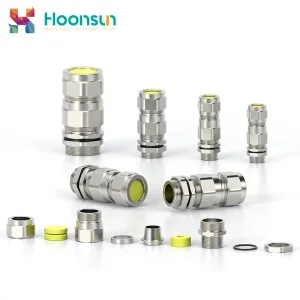
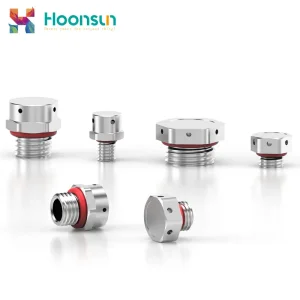
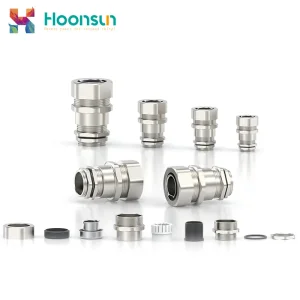
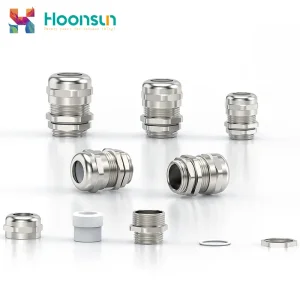
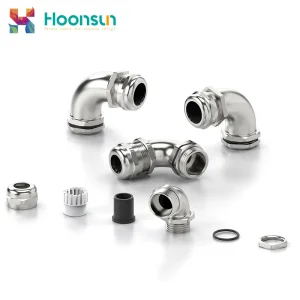
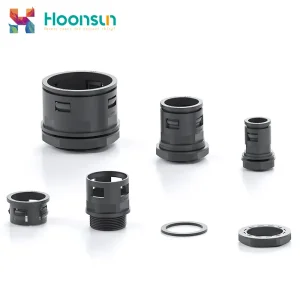
Full Engineering Series: Marine, Explosion-Proof & Specialized Entries
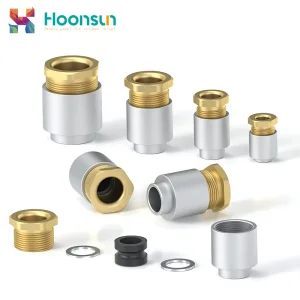
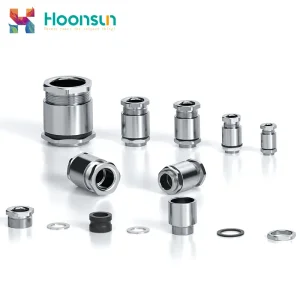
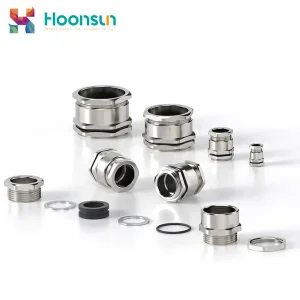
Complete assembly configurations manufactured in-house to satisfy commercial shipbuilding, offshore oil and gas, and heavy industrial vessel requirements.
Technical Clarifications
Frequently Asked Questions by Marine Engineers & Sourcing Agents
Key information regarding international logistics, material performance, electrical shielding, and certification compliance.
How do HOONSUN marine cable glands withstand Lake Ontario freeze-thaw cycles?
Standard PVC and basic nitrile seals harden and shrink below -15°C, losing seal contact against the cable jacket. HOONSUN incorporates thermoset Neoprene (CR) or customized Fluoroelastomer (FKM) sealing rings that preserve elasticity and sealing force down to -40°C, preventing capillary moisture intrusion during cold snap cycles in Ontario harbours.
What is the difference between single compression and double compression marine glands?
Single compression glands seal exclusively against the cable outer sheath, making them ideal for unarmoured cables in protected switchboards and control consoles. Double compression glands clamp both the inner sheath and the cable armour (steel wire or braided bronze), providing superior mechanical pull-out resistance and explosive gas containment required for heavy-duty machinery rooms.
Can you provide custom NPT-to-Metric adaptors for Toronto vessel overhauls?
Yes. Our Yueqing manufacturing facility operates dedicated high-speed CNC turning centers that produce custom thread conversions, including NPT to Metric, PG to NPT, and BSPP configurations. We machine these fittings in both nickel-plated marine brass and 316L stainless steel with custom pitch tolerances to fit existing control boxes.
How does HOONSUN support Canadian CSA and IEEE 45 shipboard electrical requirements?
Our product engineering models comply with standard CSA C22.2 test methods for tension, mechanical clamp retention, and electrical continuity. Comprehensive test dossiers, third-party UL certificates, and CE documentation are provided alongside factory inspection sheets with every commercial order.
What are the freight lead times for bulk delivery to Greater Toronto industrial zones?
For urgent repair projects, express air freight delivers directly to Toronto Pearson International Airport (YYZ) within 5 to 7 business days. For planned vessel overhaul cycles and OEM production runs, consolidated ocean container shipping to the Port of Montreal or direct rail transit to Toronto intermodal hubs typically requires 22 to 28 days.
How is EMC continuity preserved in hybrid and electric ferry propulsion circuits?
Our EMC-specific marine cable glands integrate an internal 360° spring-loaded brass contact ring. When tightened, the ring establishes low-impedance radial contact with the copper or bronze cable shield, diverting high-frequency interference induced by propulsion frequency converters safely to the vessel ground plane.
Connect Directly with Our Marine Sealing Engineering Team
Whether specifying high-volume OEM cable glands for switchgear manufacturing or requiring bespoke 316L explosion-proof penetrations for Toronto vessel overhauls, our factory engineering team delivers precision CAD drawings, custom samples, and competitive direct factory pricing.