
Certified Industrial Connection Systems
Explore our foundational range of heavy-caliber cable gland solutions, manufactured in full accordance with CE, UL 514B, and IEC 62444 standards for global distribution networks.
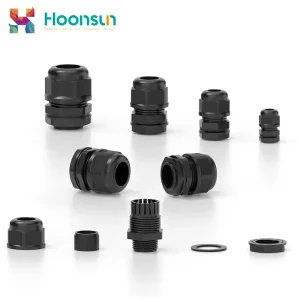
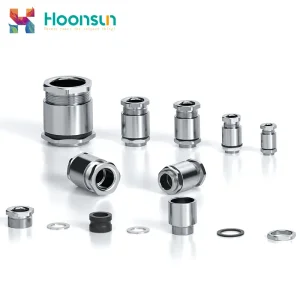
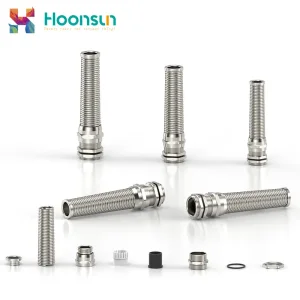
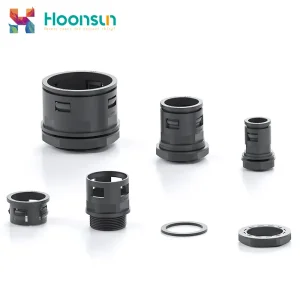
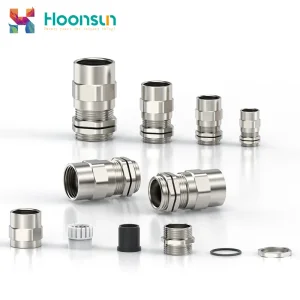
The M63 Engineering Dimension: Heavy Current Sealing & Strain Relief
In high-power industrial electrification, the metric M63 thread specification represents the critical threshold where mechanical clamping integrity, ingress barrier dynamics, and high-amp thermal dissipation intersect.
As modern distribution cabinets, commercial energy storage systems (BESS), and central utility inverters surge past 1500V DC and megawatt-scale operational loads, the demand on enclosure penetration security has never been higher. The M63 cable gland (standardized at M63 x 1.5 thread pitch) serves as the engineering gateway for heavy feeder cables spanning conductor cross-sections between 185 mm² and 400 mm², accommodating outer sheath diameters from 37.0 mm to 53.0 mm. Unlike smaller metric entries, managing an M63 junction involves absorbing immense lateral cantilever forces, preventing elastomeric creep under radial torque, and sustaining an uncompromising hermetic seal against dynamic atmospheric pumping effects.
Zhejiang Hongxiang Connector Co., Ltd. (HOONSUN) has dedicated nearly two decades of precision metallurgical and polymer manufacturing in Liushi Town, Yueqing, to establish a global benchmark for M63 execution. Backed by automated Swiss-type CNC turn-mill machining, ISO 9001:2015 controlled assembly cycles, and dual certification under UL 514B and European EN 62444 standards, our M63 catalog addresses catastrophic field failure vectors including thread galling, salt-mist induced galvanic delamination, and IP barrier degradation under extreme subsea hydrostatic pressures.
Global Megatrends Transforming High-Amperage Cable Glanding
Procurement directors and electrical systems architects across North America, the European Union, the Middle East, and Asia-Pacific face structural shifts that mandate resilient M63 fittings over commodity-grade alternatives.
1. Utility-Scale BESS & Inverters
The global shift toward centralized 3.3 MVA to 8.8 MVA solar inverter stations and multi-megawatt-hour battery energy storage enclosures requires massive multi-conductor and unarmoured power leads. High harmonic resonance and cyclic thermal variations cause ordinary glands to suffer elastomer stress relaxation, resulting in water seepage during evening cooling cycles. M63 glands with specialized EPDM and fluoroelastomer clamping inserts provide continuous resilience without loss of torque retention.
2. Offshore Wind & Marine Electrification
Offshore nacelles and marine port power distribution centers operate under harsh C5-M marine atmospheric corrosive environments. Salt spray, high humidity, and continuous low-frequency structural vibration destroy unprotected nickel plating. Heavy-duty marine M63 cable glands incorporating TJ-type double clamping mechanics and 316L austenitic stainless steel provide structural pull-out resistance exceeding 2,500 N, ensuring uninterrupted service in remote offshore arrays.
3. Hyperscale AI Data Center Infrastructure
AI compute clusters require unprecedented electrical power densities, forcing facility engineers to deploy 415V/480V three-phase busways and high-gauge power feeds into Modular Data Centers (MDCs) and liquid-cooled power distribution units (PDUs). Electromagnetic interference (EMC) caused by high-frequency switching mandates 360-degree brass contact springs inside the M63 body, ensuring low-impedance grounding and zero signal attenuation.
4. Deep Hydrogen & Hazardous Mining
The modernization of petrochemical refineries, underground deep-shaft mining conveyors, and emerging green hydrogen electrolyzer plants requires explosive atmospheric certification. M63 barrier glands and explosion-proof flameproof joints (CW/EX3 types) ensure that an internal arc flash cannot propagate outward into explosive Zone 1/2 gas or combustible dust environments, delivering total life-safety protection.
China Factory 4.0: Supply Chain Resilience, Vertical Integration & Quality Parity
How the Yueqing electrical equipment industrial cluster delivers engineering consistency, raw material sovereignty, and cost optimization for global Tier-1 OEMs.
For decades, Western EPC contractors relied on legacy European cable gland brands, often bearing lead times of 16 to 24 weeks alongside inflated distributor markups. The evolution of China's Industry 4.0 manufacturing infrastructure has completely upended this dynamic. Yueqing, recognized internationally as the heart of electrical component manufacturing, concentrates over 75% of the global brass extrusion, precision stamping, and injection-moulding supply ecosystem within a 30-kilometer radius.
At HOONSUN, this industrial concentration translates into uncompromising vertical integration. We execute every critical phase in-house: from high-precision bar stock selection (CuZn39Pb3 brass and SUS316L stainless steel) to high-speed multi-axis CNC lathe turning, micro-inch thread chasing, automated ultrasonic degreasing, and closed-loop nickel electroplating. This autonomous control eliminates external contractor bottlenecks and guarantees standard batch lead times within 10 to 15 business days.
Sub-Micron CNC Turning
Every M63 gland body and compression nut is machined on high-rigidity CNC turning centers. Thread pitches conform strictly to ISO 965-1 metric 6g/6H tolerances, preventing binding, galling, or loose backlash during high-torque field installation on cast switchgear panels.
Automated In-Line Inspection
Integrated vision sorting systems monitor 100% of sealing surface concentricity and thread chamfers. Optical measurement stations eliminate micro-burrs that could breach elastomer cable outer jackets during cap nut torque application.
Full In-House Tooling & Moulding
Our captive moulding plant handles PA66 nylon injection with halogen-free flame retardants (UL94 V-0) and compounding for specialized silicone, fluorosilicone, and high-nitrile seals, ensuring cold-impact resistance down to -60°C and heat endurance to +180°C.
M63 Cable Gland Material & Environmental Selection Matrix
Selecting the optimal gland material requires cross-referencing mechanical strain, ambient chemical exposure, thermal range, and ingress classification.
| Material Variant | Ingress Rating | Clamping Range (Outer Dia.) | Operating Temp. Range | Tensile Pull-out Strength | Primary Industrial Application | Certifications |
|---|---|---|---|---|---|---|
| Nickel-Plated Brass (Standard Heavy) | IP68 (10 Bar) / IP69K | 37.0 mm – 44.0 mm / 42.0 – 53.0 mm | -40°C to +100°C (Static) | Class A (>1,800 N) | Industrial automation, transformers, central solar inverters | UL / CE / RoHS |
| Stainless Steel 316L (Marine Grade) | IP68 (20 Bar) / IP69K | 37.0 mm – 44.0 mm / 42.0 – 53.0 mm | -50°C to +180°C | Heavy Duty (>2,500 N) | Offshore platforms, chemical washdown, coastal wind nacelles | UL / CE / DNV Spec |
| Reinforced Nylon PA66 (UL94 V-0) | IP68 (5 Bar) | 37.0 mm – 44.0 mm | -40°C to +100°C | Class B (>1,200 N) | Commercial solar array combiner boxes, outdoor telecom enclosures | UL / CE / UV Resistant |
| Explosion-Proof CW / Flameproof Ex d | IP66 / IP68 | 35.0 mm – 43.0 mm (Armoured SWA) | -60°C to +130°C | Explosion Certified Pull-out | Refineries, underground mining, LNG terminals, paint chemical bays | ATEX / IECEx / UL |
| EMC Shielded Brass (Integrated Spring) | IP68 | 37.0 mm – 44.0 mm | -40°C to +120°C | Class A (>1,800 N) | Variable frequency drives (VFDs), rail transit traction converters | UL / CE / EMC Compliant |
Proven in Extreme Terrestrial and Offshore Environments
Theoretical IP ratings collapse without real-world engineering validation. See how HOONSUN M63 cable glands sustain operational reliability across four hostile environments.
Middle East Desert PV (55°C & Dust Ingress)
In utility solar parks across the UAE and Saudi Arabia, daytime ambient temperatures push internal combiner box temperatures beyond 70°C, followed by abrupt nocturnal drops that generate strong internal negative pressures. Traditional glands experience micro-vacuums that draw airborne silica dust past dry rubber seals. HOONSUN M63 glands utilize dual-lip silicone seals with continuous radial pressure distribution and breathable membrane accessories, eliminating internal condensation and dust entry over decades of exposure.
North Sea Offshore Wind Substations
Positioned 40 kilometers offshore, converter platforms face continuous wind-driven saline fog and structural harmonic vibration from high-capacity wind turbines. HOONSUN 316L stainless steel M63 marine glands feature deep-cut internal threads, an anti-loosening serrated locknut architecture, and chloroprene compression sleeves. In third-party cyclic salt spray testing exceeding 1,000 hours, zero pitting corrosion, passivation breakdown, or sheath pullout was recorded.
Locomotive Bogies & Heavy Rail Transit
Under-car power transmission conduits in high-speed rail systems endure flying track ballast, heavy snowpack, and multidirectional high-frequency vibration during dynamic braking. HOONSUN metal anti-bending and flexible tubular M63 glands protect primary traction cables against shear strain, preventing conductor core work-hardening and maintaining continuous ground continuity.
Technical Torque & Enclosure Preparation Guidelines
A cable gland's nominal protection is only as robust as its field installation torque and enclosure opening preparation. Follow these engineering parameters for M63 deployments.
1. Clearance Hole Diameter: When installing M63 cable glands through non-threaded enclosure walls, punch or drill holes to precisely 63.5 mm (+0.4 mm / -0.2 mm). Excessive hole clearance compromises the contact face of the outer O-ring seal, risking water pooling under hydrostatic pressure.
2. Tightening Torque Parameters: Due to the large surface area of the M63 thread, applying insufficient torque leaves the elastomeric seal uncompressed, while excessive force risks stripping the internal threads or crushing cable cores.
Body into Enclosure Torque
For nickel-plated brass and stainless steel M63 bodies threaded directly into cast metal entries or secured with a brass locknut, apply a calibrated torque wrench setting of 65.0 N·m to 75.0 N·m. For reinforced PA66 bodies, limit torque to 20.0 N·m to 25.0 N·m to prevent thread deformation.
Cap Nut Compression Torque
Tighten the upper dome compression cap nut until the internal claw-finger basket uniformly contracts the elastomeric sleeve around the outer cable jacket. For standard heavy cable diameters (42 mm – 53 mm), the recommended torque is 50.0 N·m to 60.0 N·m, achieving an airtight, gas-tight seal without causing jacket extrusion.
Armoured Cable Clamping (SWA)
When installing CW-style armoured M63 glands, ensure the Steel Wire Armour (SWA) or Steel Tape Armour (STA) is stripped back cleanly by 35 mm. Clamp the steel strands evenly inside the internal conical clamping ring to deliver guaranteed mechanical pull-out resistance and low earth-fault impedance.
Frequently Asked Questions by Industrial Sourcing Engineers
Direct technical responses addressing compliance, mechanical properties, and OEM customisation from HOONSUN’s senior engineering team.
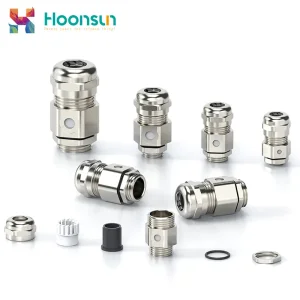
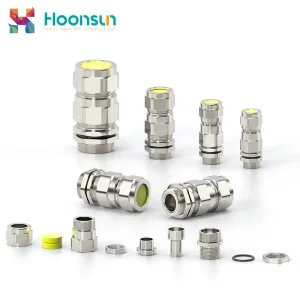
Specialized Heavy-Duty & Explosion-Proof Series
Engineered for hazardous locations, stainless marine environments, and high-pressure applications with full certification backing.
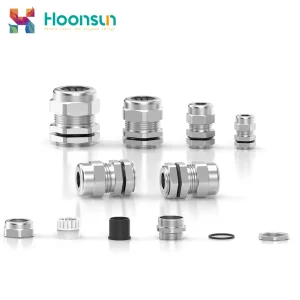
Accelerate Your Power Infrastructure Projects with Direct Factory Engineering
Eliminate trading intermediaries and long supply chain lead times. Request comprehensive M63 2D/3D CAD drawings, sample test kits, and volume manufacturer direct pricing directly from our Yueqing manufacturing facility.