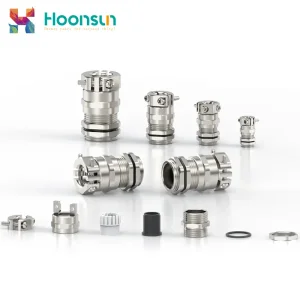
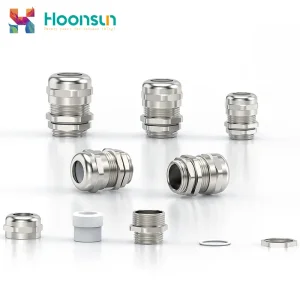
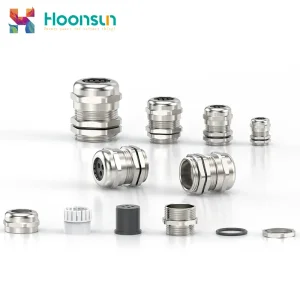
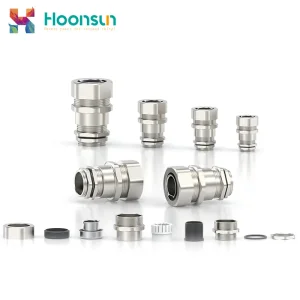
Featured Industrial Threaded Cable Gland Configurations
Precision-machined termination components manufactured in China under ISO 9001:2015, UL 514B, and EN 62444 compliance standards for hazardous, high-vibration, and marine deployments.
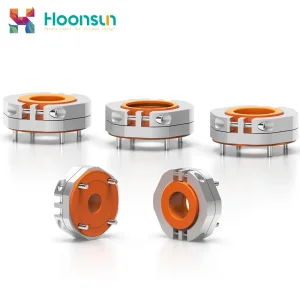
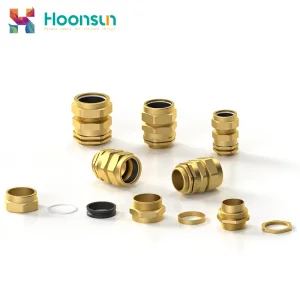
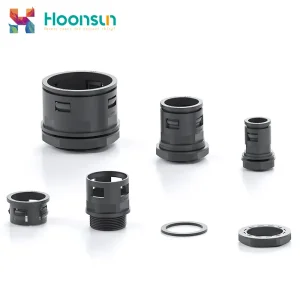
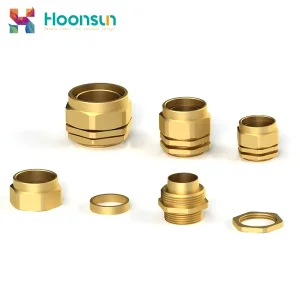
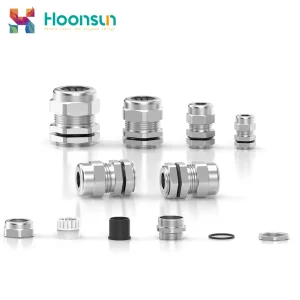
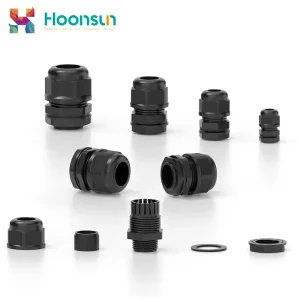
Evolutionary Trajectories in Industrial Threaded Cable Entry Systems
As electrified automation, renewable energy arrays, and AI compute architectures scale globally, cable glands have transitioned from passive mechanical fittings into active safeguards of system integrity.
Ingress Protection Dynamics (IP68/IP69K)
Modern deployments require dynamic hermetic sealing. Beyond basic static water immersion (IP68 up to 5-10 bar / 50 meters), continuous thermal cycling induces negative pressure inside electrical enclosures. High-grade elastomeric formulations (EPDM, FKM, Silicone) prevent the ingress of atomized mist and survive 100-bar high-pressure washdowns under DIN 40050-9 (IP69K).
Thread Dimensional Convergence
Cross-border EPC operations necessitate comprehensive multi-standard thread mastery. While continental Europe adheres to Metric ISO (EN 60423) and legacy installations maintain German PG (DIN 40430), North American industrial projects demand ANSI/ASME B1.20.1 NPT taper threads for gas-tight seals, complemented by British standard parallel G (BSPP / ISO 228) for specialized fluidic enclosures.
ATEX / IECEx Explosion Proofing
In chemical processing, marine terminals, and mining, cable entries must eliminate the risk of internal ignition propagating into combustible atmospheres. Cable gland designs integrate compound barrier seals (Ex d flameproof) and controlled compression seals (Ex e increased safety, Ex ta dust ignition protection) engineered to withstand catastrophic internal deflagration without rupture.
360° EMC / RFI Shielding
High-speed variable frequency drives (VFDs), EV motor powertrains, and precision robotics generate severe electromagnetic interference. Specialized brass-plated and stainless EMC cable glands utilize low-impedance radial phosphor bronze or stainless contact springs, guaranteeing 360-degree bonding to cable braiding with minimal transfer impedance across gigahertz frequencies.
Global Technical Sourcing Criteria & Performance Verification
Enterprise procurement requires stringent verification beyond catalog nominal dimensions. Leading industrial original equipment manufacturers evaluate component selection against critical metallurgical, mechanical, and regulatory criteria.
Mechanical Pull-Out & Retention (EN 62444)
Cable pull-out resistance directly affects uptime. Under international standard EN 62444 (Class A and B retention), cable glands are tested under static pull forces (exceeding 350 N to over 1500 N for large cables) without slippage beyond 3 mm. Advanced claw geometries distribute radial clamping forces evenly across circular jacket profiles without pinching or insulation creep over decade-long operation.
Corrosion & Atmospheric Degradation
Marine, coastal, and chemical installations mandate verification via ASTM B117 neutral salt spray testing. Nickel-plated brass components (CW614N/CW617N) must withstand 240 to 480 hours without base metal oxidation. Marine and washdown zones require AISI 304 (1.4301) or acid-resistant AISI 316L (1.4404) passivated stainless steel with a Pitting Resistance Equivalent Number (PREN) above 23 to resist pitting.
Gasket Chemistry & Operating Temperatures
The mechanical seal determines the long-term barrier. Standard Nitrile (NBR) rubber is optimal for industrial oils and fuel contact (-40°C to +100°C). Ethylene Propylene Diene Monomer (EPDM) provides ozone, water, and weather durability. Extreme thermal swings demand high-tear Silicone (-60°C to +200°C), while concentrated hydrocarbons require Fluoroelastomer (FKM/Viton).
| Material Classification | Common Thread Standard | Sealing Seal Polymer | Ingress Level | Pull-Out Retention (EN 62444) | Target Industrial Environments |
|---|---|---|---|---|---|
| Nickel-Plated Brass (HPb59-1) | Metric (M12 - M100) / NPT (1/4" - 4") | NBR / Modified EPDM | IP68 (10 Bar) | Class B (> 450 N) | Heavy Machinery, Motor Conduits, Automation Cabinets |
| Stainless Steel (AISI 316L) | Metric ISO / NPT / PG Thread | FKM (Viton) / Silicone | IP68 / IP69K | Class B (> 750 N) | Offshore Rigs, Chemical Refineries, Food Processing |
| Polyamide PA66 (UL 94 V-0) | PG (PG7 - PG48) / Metric | EPDM Rubber O-Ring | IP68 (5 Bar) | Class A (> 250 N) | Solar PV Inverters, Distribution Enclosures, HVAC Systems |
| Double-Lock Explosion-Proof Brass | NPT / Metric (Ex d / Ex e) | Low-Smoke Zero-Halogen (LSZH) | ATEX / IECEx | Armoured Clamping (> 1200 N) | Hazardous Gas Zones 1 & 2, Dust Zones 21 & 22 |
| Quick-Coupling Metal Hose Gland | Metric / G (BSPP) Thread | Oil-Resistant NBR | Mechanical Conduit Interlock | Industrial Robotics, Flexible Conduit Routing, Rail Bogies |
China Smart Factory 4.0: Manufacturing Precision & Vertical Scale
Centered in Liushi, Yueqing (the global capital of low-voltage electrical apparatus), Chinese manufacturing clusters integrate raw material metallurgy, multi-axis precision machining, and automated assembly within a single resilient supply chain.
Multi-Axis High-Speed CNC Lathes
Precision turning centers operate with high-speed automated bar feeders. Single-setup machining processes inner thread profiles, exterior spanner flats, and O-ring sealing grooves, eliminating cumulative clamping errors and holding tight tolerances within 6g/6H ISO thread classes.
Automated Optical Inspection (AOI)
Machine vision integration inspects 100% of finished connector threads for micro-burrs, pitch deviations, and minor diameter anomalies before surface finishing. Optical laser measurement ensures that metal hose union locking interfaces mate smoothly with target conduits without binding.
Surface Coating & Plating Lines
Automated electroplating lines apply uniform nickel coatings (5–10 μm) adhering strictly to ISO 1456. Environmentally controlled rinsing and passivating cycles eliminate hexavalent chromium, ensuring RoHS 3 compliance and superior salt spray resistance.
Regional Raw Material Integration
The Yueqing industrial cluster sources raw brass billets (CW614N/CuZn39Pb3), virgin PA66 granules, and high-tensile stainless steel rod within a 20-mile operational radius, providing short production lead times and insulating international distributors from global logistic bottlenecks.
Global Industrial Landscape: Regional Demands & Commercial Trends
Procurement demands diverge across geographic regions based on regional electrical codes, climatic extremes, and specific industrial modernization initiatives.
North America (NEC & UL Standards)
The US and Canadian markets are defined by NEC Article 500/505 guidelines, requiring NPT threads for explosion-proof conduits (Class I, Div 1 & 2). Rapid expansion in utility-scale Battery Energy Storage Systems (BESS) is driving demand for UL 514B listed liquid-tight fittings and heavy-gauge cable glands supporting high-amperage direct current connections.
Europe (CE, ATEX & Green Transition)
Strict adherence to the EU Low Voltage Directive, RoHS 3, and REACH regulations defines European procurement. Engineering firms demand halogen-free, self-extinguishing polyamide (UL 94 V-0) and stainless steel glands for offshore wind farms, hydrogen production facilities, and rail infrastructure governed by the EN 45545-2 fire behavior standard.
Middle East & GCC (Harsh Petrochem)
In the GCC region, cable entry equipment must resist intense ultraviolet exposure, fine airborne sand, and ambient temperatures exceeding 50°C. Refineries, LNG terminals, and solar mega-projects specify dual-certified ATEX/IECEx explosion-proof brass glands fitted with UV-stabilized silicone gaskets to avoid polymer embrittlement.
Asia-Pacific (Advanced Manufacturing)
Industrial automation hubs across Japan, South Korea, Taiwan, and Southeast Asia generate strong demand for high-density multi-hole cable glands, flexible metal hose fittings, and cleanroom-compliant stainless connectors used in robotics, fab tool manufacturing, and high-speed rail networks.
Mission-Critical Deployment Scenarios
From AI data center thermal loops to offshore wind turbine nacelles, customized cable gland and coupling designs prevent electrical faults and fluid ingress under demanding conditions.
AI Data Centers & Liquid Cooling Manifolds
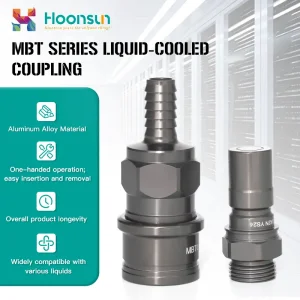
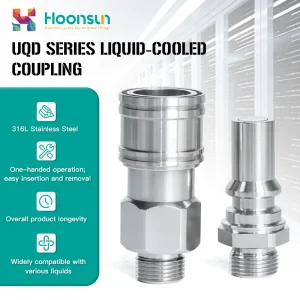
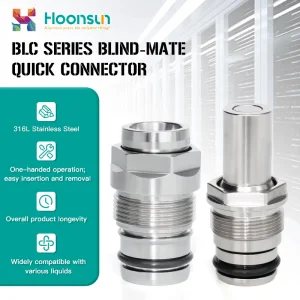
Hyperscale artificial intelligence compute racks utilize liquid-to-chip cooling loops with high-performance blind-mate quick couplings (UQD and BLC series). Coupled with IP68 cable seals on power distribution blocks, these fittings guarantee zero-drip disconnections, preventing coolant leakage near server motherboards and GPU arrays.
Offshore Wind & Subsea Substations
Offshore nacelles and inter-array transition boxes face continuous salt spray, high humidity, and wave action (C5-M atmospheric corrosivity). HOONSUN marine TJ-clamping and BWL-type cable glands use marine-grade brass and 316L stainless steel to secure heavy armoured copper power cables against vibration and mechanical pull.
Rolling Stock & Rail Transit Systems
Under-car bogies, roof-mounted pantographs, and inter-car jumpers experience constant vibration and road debris impacts. Double-lock metal cable glands with flexible conduit unions provide mechanical strain relief and vibration protection tested per IEC 61373 railway shock standards.
Robotic Automation & Multi-Core Cabling
Six-axis articulation arms route power, sensor, and industrial ethernet lines through tight bulkhead openings. Multi-hole IP68 metal cable glands allow up to eight independent signal conductors through a single gland body, preserving clean layout, reducing enclosure footprint, and preventing cable chafing.
Technical & Procurement FAQ for Industrial Cable Glands
Clear answers to the mechanical, electrical, and specification questions asked by engineering procurement teams.
High-Performance Couplings & Heavy-Duty Glands
Liquid cooling connectors, explosion-proof double lock joints, and multi-cable management hardware engineered for computing, rail transit, and automated manufacturing.